Maximizing perimeter utility remains one of the primary spatial challenges in
modern kitchen and architectural millwork design. Corner spaces present
geometric hurdles where perpendicular surfaces intersect, frequently resulting
in inaccessible voids or compromised structural integrity if engineered
improperly. For commercial property developers, multi-family housing procurement
directors, and high-end interior contractors, resolving these intersections
requires an acute balance of technical engineering, specialized hardware
integration, and repeatable mass manufacturing. Securing a reliable corner
cabinets exporter bridges the divide between complex architectural shop drawings
and scalable, defect-free site delivery.
Cabinetry exports demand high-tolerance precision. A standard carcass
requires baseline stability, whereas corner units carry asymmetric mechanical
loads, complex dynamic pivot mechanisms, and tight clearance margins. A
millimeter discrepancy in carcass squareness or edge-banding adhesion compounds
down an entire installation line, halting site workflows and driving up
operational overhead. Examining the technical blueprints, production
technologies, material sciences, and logistics workflows that define modern
corner cabinet manufacturing provides an objective roadmap for international
procurement teams.
Geometric Typologies and Mechanical Engineering in Corner Architecture
Specifying corner millwork requires navigating distinct architectural
footprints, each dictating specific internal clearances, hinge sweeps, and
loading vectors. Commercial projects typically deploy three primary structural
typologies, each carrying unique engineering constraints.
- Blind Corner Bases: Utilizing a single functional door
adjacent to a blank decorative panel, these units run continuously into an
intersecting run. The primary mechanical challenge lies in access depth. Without
specialized mechanical fittings, the blind section creates deep, dark dead
zones. Engineering must account for door clearance against intersecting pull
handles, demanding precise filler strip calculations.
- L-Shaped (90-Degree Diagonal or Bi-Fold): Following the
profile of the room's corner directly, L-shaped units deploy either bi-fold
doors linked via specialized 170-degree hinges or open angled fronts. Bi-fold
variants require precise gap tolerances to prevent edge-to-edge binding during
simultaneous swing cycles, demanding rigid frame stabilization.
- Diagonal (Canted) Cabinets: Bridging the intersection via a
diagonal 45-degree front face, these designs expand internal volume
significantly. However, they alter countertop fabrication templates and require
deep reaches, shifting structural weight forward toward the cantilevered front
face.
Structural stability begins with rigid carcass construction. Diagonal and
blind layouts inherently experience uneven torsional stress when internal
shelving or mechanical arms are loaded to capacity. Premium production lines
eliminate structural warping by abandoning standard 15mm paneling in favor of
18mm or 20mm balanced structural components, supplemented by continuous top
stretchers and rear stabilization rails anchored through high-density mechanical
fasteners.
Material Substrates, Core Integrity, and Environmental Performance
Substrate selection dictates how finished joinery withstands humidity
fluctuations, mechanical wear, and trans-oceanic shipping environments. An
experienced corner cabinets exporter prioritizes core materials that combine
structural rigidity with strict chemical emissions compliance.
Engineered Wood Core Compositions
Medium-Density Fiberboard (MDF) and Particleboard (Chipboard) remain the
baseline for contemporary kitchen casework. Particleboard used in export-grade
corner carcasses must meet moisture-resistant criteria (MR or P3/P5 grading).
Standard grade particleboard expands rapidly when subjected to edge-penetrating
humidity, compromising hinge screw retention. Premium casework frequently
specifies Marine-grade, high-density Multi-Layer Plywood for base corners,
especially beneath sink locations where moisture exposure spikes. Plywood
delivers superior flexural strength, resisting shear failure under the dynamic
loads created by extended pull-out trays.
Surface Treatments and Edge Sealing Standards
Laminates, thermally fused melamines (TFM), and natural wood veneers demand
hermetic edge sealing to isolate core fibers from ambient atmospheric
conditions. Conventional Ethylene Vinyl Acetate (EVA) hot-melt adhesives fail
over time in humid environments, leaving a visible glue line that weakens under
thermal stress. Modern manufacturing specifications call for Polyurethane
Reactive (PUR) adhesive technologies or direct Hot Air/Laser zero-joint edge
banding. PUR forms chemical cross-links within the substrate fibers, yielding a
nearly invisible bond line with moisture resistance and thermal stability
ranging from minus 40 to over 100 degrees Celsius.
Emissions and Environmental Certification
International procurement frameworks require certified verification of
volatile organic compound (VOC) levels. Quality millwork manufacturing adheres
to rigorous emission thresholds, satisfying California Air Resources Board
(CARB) Phase 2, EPA TSCA Title VI, and European E1/E0 standards. Sustainable
sourcing mandates Forest Stewardship Council (FSC) Chain of Custody
certification, verifying that wood fibers originate from sustainably managed
timber stands.
Hardware Kinematics: Maximizing Inaccessible Volumetric Capacity
A corner cabinet functions only as effectively as its mechanical hardware.
Stagnant shelving within a 900mm-deep corner module is fundamentally obsolete in
high-end design. Sourcing commercial-grade units requires an analysis of
kinematic hardware systems engineered for high weight ratings and cyclical
endurance.
Mechanical Optimization Systems
- LeMans / Kidney Trays: Featuring organically curved
floating shelves that articulate completely outside the carcass envelope, these
systems rely on vertical mounting columns attached to the carcass wall and base.
The engineering emphasis rests entirely on pivot arm tensile strength and smooth
deceleration dampers, supporting upwards of 25 kilograms per tray without
downward deflection.
- Magic Corner / Articulated Pull-Outs: Utilizing
front-door-mounted frames linked to internal sliding chassis, opening the front
assembly simultaneously pulls internal back-corner wire baskets forward along
heavy-duty bottom tracks. High-grade ball-bearing slides and cold-rolled steel
link arms are non-negotiable here to eliminate racking and door sag.
- Three-Quarter and Full-Circle Lazy Susans: Centered on an
adjustable central steel pole, revolving carousels remain a staple for symmetric
L-shaped layouts. Modern iterations favor independent tray rotation with
anti-slip textured bases, integrated rim guards, and soft-centering mechanical
detents that quietly guide the doors back into alignment.
Leading fabricators integrate hardware from globally certified hardware
producers such as Blum, Grass, or Kesseböhmer, ensuring that dynamic elements
guarantee a minimum of 50,000 to 100,000 operational cycles under maximum load
ratings. Essent Home engineers internal cabinet sub-assemblies around
pre-drilled CNC boring patterns matched down to the half-millimeter,
guaranteeing zero-play mounting compatibility with these high-performance
kinematic systems.
Finding a competent manufacturing partner requires looking beyond simple
aesthetic surface finishes. Commercial buyers need absolute confidence in
industrial scalability, precision manufacturing machinery, and rigorous quality
assurance ecosystems.
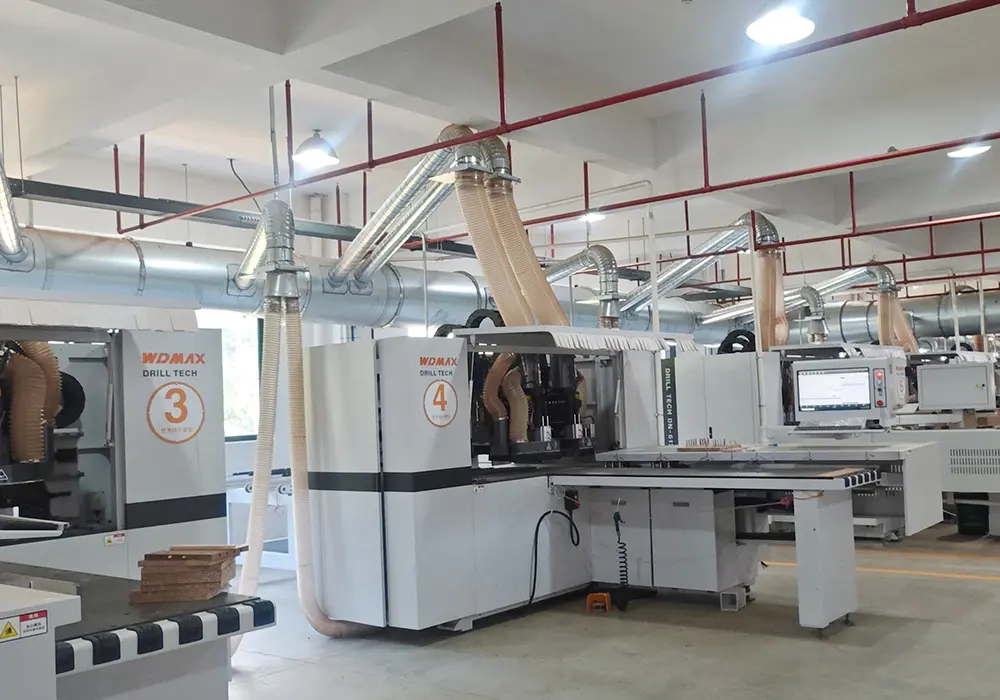
Automated CNC Nesting and Tolerances
Modern volumetric millwork production depends on high-precision computerized
numerical control (CNC) machining centers. Panel cutting, vertical boring, line
drilling, and horizontal edge grooving should ideally execute in synchronized
automated nesting environments. Human manual repositioning during fabrication
introduces cumulative geometric errors. A premier corner cabinets exporter
maintains automated production tolerances within ±0.3mm across large-scale runs,
guaranteeing that every mortise, dowel bore, and cam-lock pocket interfaces
flawlessly during on-site assembly.
Rigorous Quality Control Checkpoints
An enterprise-level manufacturing facility deploys formal Quality Control
(QC) protocols across every production phase. This includes Incoming Material
Quality Control (IQC) testing board moisture content and core density,
In-Process Quality Control (IPQC) checking dimensional drift and edge-banding
adhesion strength via peeling tests, and Final Quality Control (FQC). Prior to
packing, full carcass mockups must be erected on factory staging floors to test
squareness, door reveal consistency (standardized to 2.5mm–3mm margins), and
kinematic balance under load.
Facilities like Essent Home establish end-to-end traceability across batch
production lines. Standardized scanning of individual component barcodes
confirms that all machined panels, edge-sealed parts, and complementary assembly
hardware packages align with project shop drawings before reaching packaging
logistics.
Packaging Engineering and International Logistics Protocols
Exporting custom millwork across intercontinental trade lanes exposes crated
cabinetry to dynamic impact, vibration resonance, humidity saturation, and
maritime climate extremes. Securing specialized product integrity demands
deliberate packaging science.
Flat-Pack (RTA) versus Fully Assembled Freight Optimization
Logistical efficiency dictates the shipping format chosen based on
landing-site capabilities:
- Flat-Pack (Ready-to-Assemble): Yields exceptional container
space utilization, minimizing cubic meter (CBM) freight metrics. High-density
packing layers utilize heavy honeycomb corrugated cardboard outer boxes,
separated by high-density polyethylene (EPE) foam sheeting to eliminate surface
micro-abrasions. Panel edges are secured using multi-layer molded plastic corner
guards capable of absorbing substantial edge-impact velocity during intermodal
transport.
- Rigid (Factory Assembled): Drastically shortens on-site
installation timelines and labor overhead in high-cost commercial markets. Fully
clamped, glued, and squared carcasses require robust internal bracing to prevent
dynamic racking forces from popping joints loose while in container transit.
External crating demands reinforced wooden skeleton crates or enclosed plywood
shipping boxes constructed to ISPM 15 heat-treated phytosanitary
standards.
Environmental Protection in Maritime Transit
Containers crossing equatorial zones endure dramatic ambient temperature
drops, generating internal "container rain" or condensation cycles. A
professional corner cabinets exporter incorporates moisture desiccant bags
containing calcium chloride inside every packed unit envelope, wrapping
individual boxes in hermetically sealed, tear-resistant stretch film. This step
neutralizes relative humidity surges, preventing substrate swelling, veneer
delamination, or premature surface oxidation on steel kinematic runners.
Frequently Asked Questions (FAQ)
How do blind corner base cabinets differ from standard corner base cabinets
in manufacturing specs?
Blind corner cabinets feature an extended, non-visible carcass zone that
tucks behind an intersecting cabinetry run, requiring precise interior access
hardware and a non-functional blind panel. Mechanically, they require
specialized door offset clearance hinges (typically 95° to 110° thick-door
hinges) and extended internal carcass reinforcements to support dynamic
swing-out trays. Standard corner bases, such as diagonal or 90-degree L-shaped
units, distribute loads symmetrically, have two visible access panels or bi-fold
doors, and utilize center-pole carousels or angled interior partitions.
What core substrate provides the best balance of screw retention and
stability for corner cabinetry?
High-Density Moisture-Resistant Plywood (7-ply to 9-ply birch or eucalyptus
core) offers the best structural performance for corner cabinetry due to its
cross-laminated grain orientation. This structure maximizes screw retention
resistance along both face and edge planes, which is crucial when securing
cantilevered hardware brackets. For projects balancing structural criteria with
budgetary parameters, moisture-resistant particleboard (P5 grade) treated with
high-pressure melamine balances flat surface stability with adequate dimensional
durability.
Can corner cabinet units be shipped pre-assembled with pull-out hardware
pre-installed?
Kinematic hardware is generally separated from the main carcass during
transit. While the carcass may ship fully assembled and clamped, heavy moving
metal elements—such as articulating twin shelves or pull-out carousels—are
typically flat-packed within distinct sub-cartons using pre-drilled pilot holes.
Pre-installing moving mechanical systems inside the cabinet leaves heavy metal
components prone to shifting during maritime transit, which can shear internal
mounting screws or structurally fracture the surrounding carcass walls.
What edge-banding technology is best suited to prevent delamination on
export cabinetry?
Polyurethane Reactive (PUR) edge banding and zero-joint hot air/laser edge
banding are superior to traditional EVA adhesives. PUR creates an irreversible
chemical bond that seals the core against steam, ambient moisture, and high
heat. This process leaves an extremely thin, waterproof joint line, ensuring
that the cabinet perimeter will not delaminate, even during maritime transit or
long-term placement in warm, humid coastal installations.
How does a corner cabinets exporter manage dimensional tolerances when
combining wood with complex metal mechanisms?
Precision is managed by anchoring both panel machining and metal component
fabrication to synchronized digital CAD/CAM templates. Wood panels are cut and
bored using high-precision CNC routers operating within an active tolerance of
±0.3mm to ±0.5mm. Concurrently, metal tracks, mounting plates, and pivot arms
are manufactured via laser cutting and automated stamping dies. Factory trial
mockups are conducted where hardware runs are mounted directly to
production-line panels to guarantee mechanical fluidity, zero-binding door
closures, and uniform shadow lines prior to crating.
Procurement and Custom Manufacturing Partnerships
Balancing spatial efficiency, architectural durability, and production
scalability requires systematic engineering. From substrate selection and
chemical bonding durability to automated CNC milling and protective packaging
design, every step in the production chain influences the success of an interior
installation. Partnering with a dedicated manufacturer removes volatility from
the procurement process, providing the precision casework demanded by high-tier
commercial, multi-family, and hospitality developments.
Submit your architectural blueprints, hardware schedules, and complete
project specifications directly to the engineering team at Essent Home to
initiate a detailed manufacturing feasibility analysis, prototype planning, and
competitive bulk pricing review.


![Top 7 Bespoke Corner Cabinets Manufacturers for Luxury Residences [2026 Guide]](https://essentfurniture.com/view/pc/static/img/02692ea75f4838e.webp "Top 7 Bespoke Corner Cabinets Manufacturers for Luxury Residences [2026 Guide]")