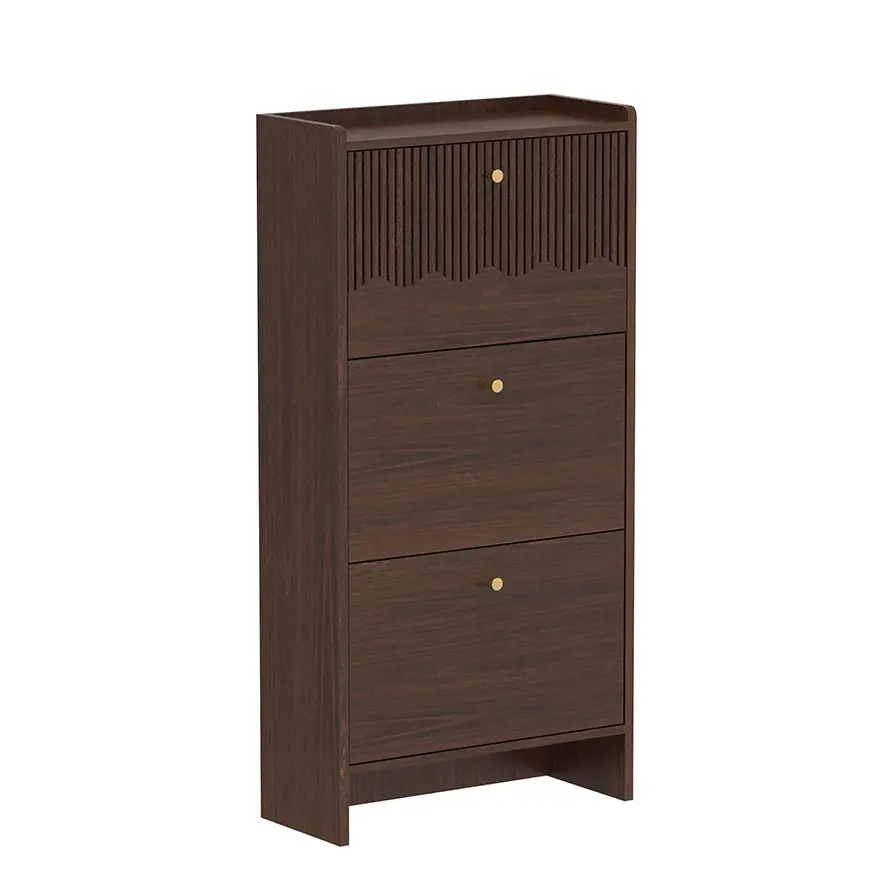
For developers, general contractors, and procurement teams handling
multi‑unit residential (MUR), student housing, or hospitality projects, the
decision to work with an entryway shoe storage ODM (Original Design
Manufacturer) instead of a standard wholesaler is a strategic lever. ODMs
control the entire chain—from initial concept engineering, mold development,
material sourcing, to final assembly and global logistics. However, not every
factory is equipped to handle the structural demands, finish consistency, and
compliance documentation required for commercial‑scale orders. This article
dissects seven verifiable criteria to audit potential entryway shoe storage ODM partners, with technical
benchmarks and risk‑mitigation tactics derived from real B2B projects.
1. ODM vs. OEM: Understanding the Depth of Engineering Responsibility
Many suppliers claim ODM capabilities, but true entryway shoe storage ODM providers design from basic
function to final form. They invest in internal tooling, jigs, and CNC
programming. Key differentiators include:
In‑house industrial design team: Capable of producing 2D
shop drawings and 3D renderings within 1‑2 weeks after receiving your spatial
constraints (corridor width, plinth height, ceiling clearance).
Finite Element Analysis (FEA) for load‑bearing parts:
Predicts deflection in shelves holding 20+ footwear pairs. This prevents sagging
after two years.
Prototyping speed: A competent ODM can deliver a functional
sample via 3D‑printed or machined components in 15 calendar days.
Verify the factory’s design software (SolidWorks, AutoCAD Inventor) and ask
for case studies where they resolved a client’s space inefficiency—for example,
converting a dead corner into a rotating shoe carousel. Without this depth, you
are merely buying a private‑label product, not a customized engineering
solution.
2. Tooling Investment & Cost Amortization Models
One of the first questions for any entryway shoe storage ODM concerns tooling fees.
Aluminum extrusion dies, injection molds for corner connectors, or thermoforming
molds for back panels can range from $3,000 to $25,000. Professional ODMs offer
transparent amortization schedules:
Fully absorbed tooling: Cost divided across first 500–1000
units, then removed from subsequent orders.
Shared tooling: Factory retains mold ownership but offers
reduced per‑unit price after defined volume threshold.
Client‑owned tooling: Full control but requires storage
fees. Best for long‑term exclusive designs.
Request a tooling cost breakdown per component (side panel extrusion, hinge
base, shelf clip). Also ask about tool steel hardness (HRC 48–52 for injection
molds guarantees 200,000+ cycles). A factory that avoids disclosing tooling
specifics often lacks engineering maturity.
3. Material Traceability & Third‑Party Test Reports
Specifying an entryway shoe storage ODM for markets like the EU or
North America demands full material traceability. Request:
Batch‑level certificates for particleboard/MDF (CARB Phase
2 / TSCA Title VI / E1).
Powder coating spectrograms to confirm salt spray
resistance ≥500 hours (ASTM B117).
Adhesive VOC reports (EN 13986 or CDPH v1.2).
Hardware brand partnerships – ODMs using Blum, Hettich, or
Salice slides provide certified cycle test data (80,000+ cycles).
Better ODMs maintain a material laboratory on‑site. During factory audits,
check if they perform peel tests on edge banding (resistance ≥70 N/25mm) and
impact resistance (IK code 06 or higher). Without these, warranty claims become
frequent on high‑use entryways.
4. Custom Finish Capabilities: From RAL Matching to Digital Printing
Architectural variety is a major reason to choose an entryway shoe
storage ODM rather than a standard catalog supplier. Evaluate finish
options:
High‑gloss acrylic (≥95 gloss units) – requires a dust‑free
spray booth and UV curing. Inquire about orange‑peel inspection standards.
Wood veneer with real‑time grain matching – competent
factories use a veneer splicer and offer sequence numbering for consistent
book‑matching across 50+ units.
Digital print on laminate – allows brand patterns, murals,
or wayfinding graphics. Resolution should be at least 720 dpi with UV‑resistant
inks (tested to 500 hours QUV).
Soft‑close add‑ons – not just hinges but also telescopic
slides with integrated dampers. Check if the ODM programs dampening force
(Newton rating) for door weight.
For large contractors like Essent Home, an experienced ODM will
produce a “golden sample” that serves as the visual benchmark for mass
production, signed off by both quality teams.
5. Lean Production & Quality Control Gates
When scaling from prototype to 1,000+ units, process consistency separates
professional entryway shoe storage ODM partners from
job shops. Request details on:
First article inspection (FAI): A complete dimensional and
functional check before any batch production. Critical dimensions (depth, hinge
distance, shelf pitch) must hold ±0.5mm.
Statistical process control (SPC): For high‑volume,
monitors panel sizing and edge banding temperature in real time.
In‑process QC: At least three checkpoints (pre‑assembly,
after hardware mounting, and final packing). Defect classification should follow
ANSI/ASQ Z1.4 with AQL 1.5 for major defects.
Final random drop test: One assembled cabinet from every
pallet is dropped from 30 cm onto each edge (ISTA 1A).
Furthermore, ask about their non‑conformance reporting (NCR) system. A
reliable ODM provides root cause analysis and corrective action within 48 hours
of detecting a batch deviation.
6. Logistics & Modular Packaging for Jobsite Assembly
ODM advantages include designing for flat‑pack or knockdown (KD) shipment to
reduce freight costs by 30‑50%. However, jobsite assembly instructions and part
labeling become critical. Check these ODM capabilities:
KD hardware bagging: Each cabinet’s screws, dowels, and cam
locks are individually packed with a QR code linking to an assembly video.
Pallet optimization software: Cube utilization above 85%
reduces shipping containers needed. Ask for a packing plan before ordering.
Regional consolidation hubs: For large projects (200+
units), an ODM with warehouses near port of entry can perform last‑mile sorting
and deliver per floor/unit.
Replacement part logistics: 2% extra hardware and spare
panels stored for 5 years – this is standard for qualified ODMs.
For example, Essent Home implements a digital packing list that
links each carton to a specific apartment number, saving general contractors
from sorting delays. Such service requires strong ERP integration, which
separates advanced ODMs from basic suppliers.
7. Intellectual Property Protection & Exclusive Design Contracts
When you commission a unique entryway shoe storage ODM design, IP security is a
major concern. Professional factories sign non‑disclosure agreements (NDA) and
non‑compete clauses that prevent selling your design to competitors. Ask
for:
Design ownership contract: Specifies that all tooling, CAD
files, and production processes belong to the buyer after full tooling
reimbursement.
Factory audit rights: Permits unannounced visits to ensure
no unauthorized production runs.
Component source blacklisting: Prevents the ODM from using
reverse‑engineered parts from third‑party suppliers.
In addition, look for ODMs that have achieved ISO 27001 (information
security) or at least have a secure data room for file exchange. Many B2B
clients now make cybersecurity part of their vendor scorecard.
Technical Comparison Table: ODM vs. Standard Supplier
To summarise the advantages, the table below contrasts a qualified entryway shoe storage ODM with a generic
importer:
Custom sizing: ODM – any width/height/depth (100‑2400mm);
Standard – fixed sizes only.
Lead time for 500 units: ODM – 45‑60 days (including
tooling); Standard – 30 days (ex‑stock but no customization).
Finish matching to RAL/Pantone: ODM – yes, with
spectrophotometer verification; Standard – limited to 5‐6 colors.
Documentation for LEED/WELL: ODM – provided full EPD, HPD,
and VOC certificates; Standard – rarely available.
After‑sales engineering support: ODM – dedicated project
manager for 24 months; Standard – email ticketing only.
This data reinforces that for projects exceeding 200 units or requiring
distinctive design, an entryway shoe storage ODM delivers lower total cost of ownership despite higher initial engineering
fees.

Case Example: Hospitality Renovation with Custom Shoe Towers
A hotel chain required 850 entryway shoe storage units for a full renovation
across 12 properties. They selected an entryway shoe storage
ODM to integrate with existing millwork and a proprietary antimicrobial
interior. The ODM developed a telescopic pull‑out system with a 40‑kg dynamic
load rating and a finish that matched the newroom’s oak veneer. By using modular
side panels, the ODM reduced field installation time by 55%. Project completion
was 10 days ahead of schedule. This exemplifies why procurement teams
increasingly prioritize ODM partnerships over off‑the‑shelf sourcing.
Frequently Asked Questions (FAQ)
Q1: What is the typical minimum order quantity (MOQ) for an entryway shoe
storage ODM?
A1: MOQ depends on complexity. For simple laminated MDF cabinets with
standard hardware, MOQ often starts at 100-200 units. For designs requiring new
aluminum extrusion dies or custom injection‑molded connectors, MOQ may be 500
units to amortize tooling. However, some ODMs offer a “prototype to pilot”
service (30-50 units) for design validation. Essent
Home provides flexible tiers starting from 50 units for repeatable
configurations.
Q2: How do I protect my design when working with an Asian‑based ODM?
A2: Sign a clear manufacturing agreement that includes an IP assignment
clause, non‑circumvention, and non‑compete. Register your design in the target
country (e.g., EU design registration or US design patent). Also request that
the ODM signs a separate confidentiality agreement. Many professional ODMs have
experience with US/EU clients and accept escrow of tooling drawings.
Q3: What documentation should an ODM provide for US building code
compliance?
A3: For US projects, request flame spread test reports (ASTM E84, class A or
B valid), formaldehyde emissions as per TSCA Title VI, and ADA clearance
compliance (if installed in public corridors). Additionally, ask for hardware
cycle test reports to ANSI/BHMA A156.9. An experienced entryway shoe storage ODM will supply these in a
ready‑to‑submit binder for the general contractor.
Q4: Can an ODM integrate smart features like app‑controlled lighting or
occupancy sensors?
A4: Absolutely. Advanced ODMs offer low‑voltage wiring channels embedded in
side panels. They can pre‑install LED strips with motion sensors (battery or
AC). For higher‑end projects, some ODMs integrate UHF RFID readers for
locker‑style tracking. Discuss the power supply routing early; professional ODMs
will modify the back panel design to fit certified components.
Q5: What is the typical lead time for a pilot run (50 units) with custom
finishes?
A5: A pilot run generally requires 30-40 working days from final approval of
shop drawings. This includes material ordering (special veneers or RAL‑matched
powder), CNC programming, and first article inspection. For urgent projects, an
efficient entryway shoe storage ODM can compress
to 25 days with expedited wood supply, but expect a 15‑20% cost premium for rush
orders.
Ready to move from
requirements to a manufacturable design? Send your architectural drawings,
target price per unit, and estimated annual volume to our ODM engineering desk.
We will return a feasibility study, tooling amortization table, and 3D concept
within 5 business days. Submit your RFQ directly and a project manager
will arrange a secure video factory tour and sample approval workflow.