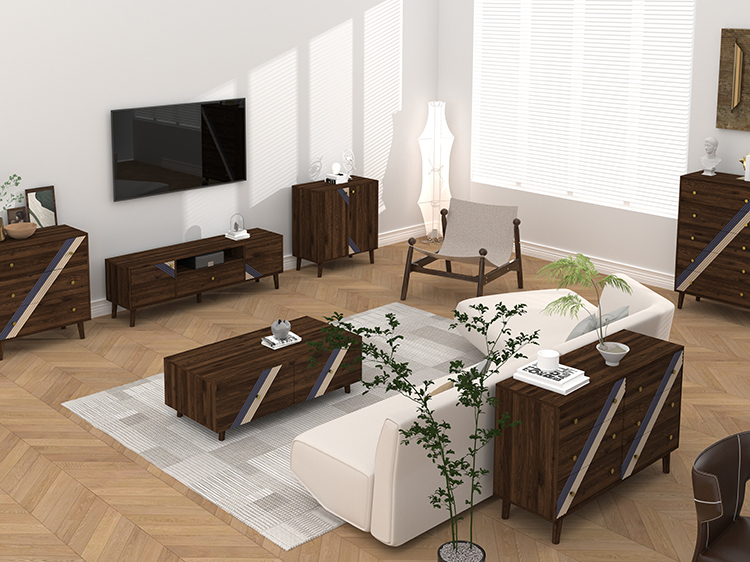
For property developers, hotel chains, and interior design firms, selecting
an entertainment center ODM partner determines
product distinctiveness, supply chain reliability, and long-term maintenance
costs. Unlike OEM (producing to existing designs), ODM (Original Design
Manufacturing) grants buyers exclusive access to in-house industrial design,
mechanical engineering, and certified testing — without funding a full R&D
department. This guide dissects technical workflows, material science choices,
and validation methodologies that define professional-grade media cabinetry. Essent Home applies these principles across
international projects, from extended-stay suites to luxury high-rises.
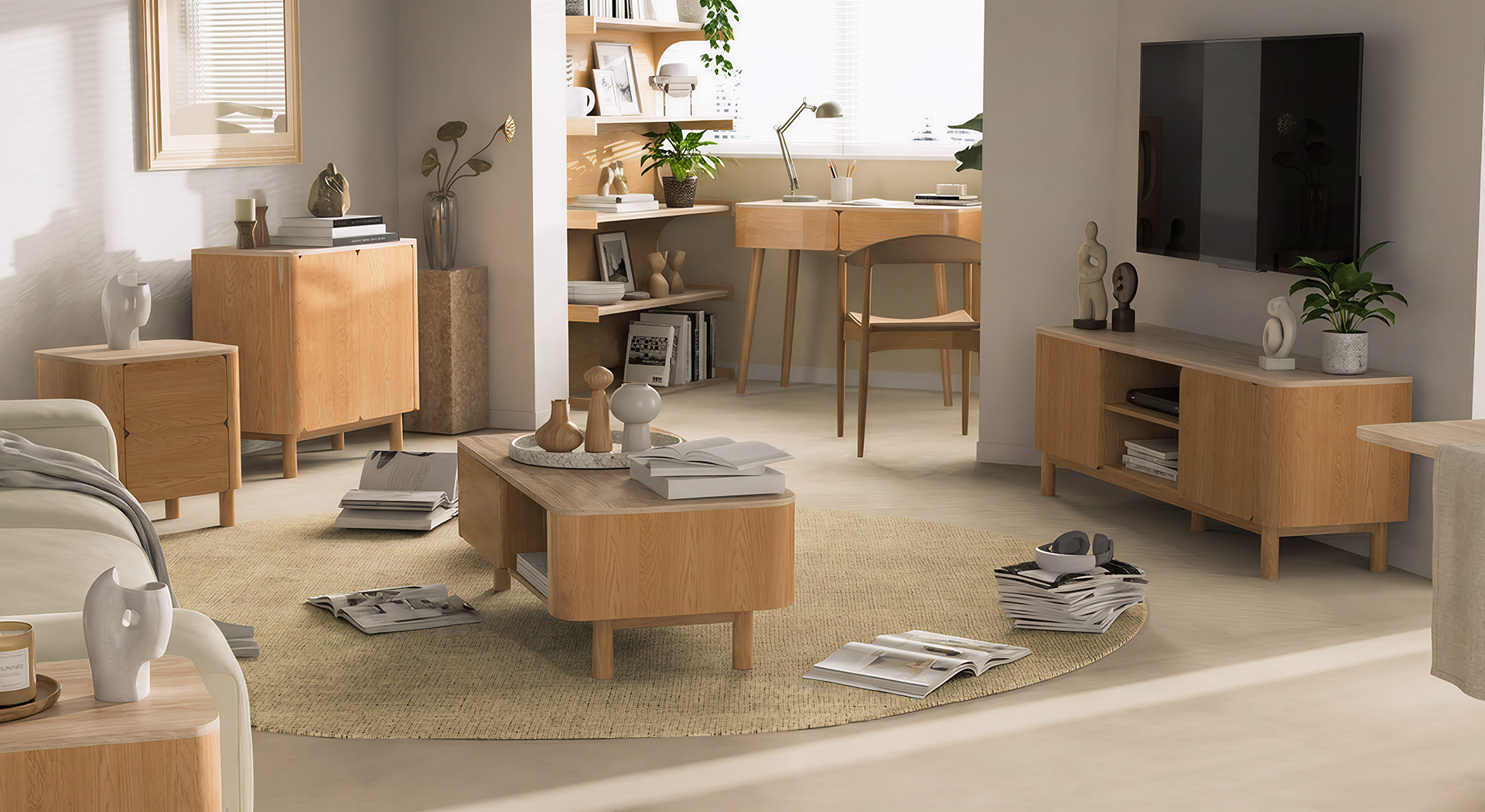
A robust entertainment center ODM process starts with
concurrent engineering: industrial designers, structural engineers, and CNC
programmers collaborate from sketch phase. This eliminates common handoff
errors. Key technical outputs include:
Parametric 3D models with embedded joinery details (dado
depths, tenon tolerances) for direct CAM output.
Finite element analysis (FEA) reports for shelf deflection
under distributed loads (e.g., 50kg amplifier + 30kg vinyl collection).
Assembly sequence simulations to minimize part count and
reduce onsite installation errors for flat-pack shipments.
In-house prototyping using 5-axis CNC enables iterative refinement of cable
management channels and ventilation slots. For a recent 400-unit residential
project, the ODM team reduced thickness of rear panels from 12mm to 8mm while
adding structural ribs — cutting material weight by 22% without compromising
stiffness.
2. Material Specification & Sourcing for Commercial Durability
Volume production for entertainment center ODM contracts
requires documented material traceability. Below are industry-standard
substrates and their performance benchmarks:
| Material | Key
Property | Test
Standard | Typical
Application |
|---|
| E0-grade
MDF | Formaldehyde
<0.05ppm | EN
16516 | Bedroom
media consoles |
| Marine
plywood (9-ply) | Water
immersion pass (72h) | ASTM
D1037 | Coastal
resort cabinets |
| Phenolic
resin board | Fire
rating B-s1,d0 | EN
13501-1 | Public
area AV units |
Leading ODM factories maintain bonded warehouses for high-turnover hardware
(hinges, drawer slides, cam locks) from European or Taiwanese suppliers. For
example, Essent Home stocks Blum clip-on hinges with
integrated silencers, ensuring consistent performance across batches. Any
material substitution requires written deviation approval — a clause protecting
the buyer’s specified surface durability.
3. Integrated Electronics & Passive Cooling Strategies
Modern entertainment centers house heat-generating components (AV receivers,
game consoles, network switches). Standard ODM designs often incorporate three
cooling tiers:
Natural convection: 20mm gaps above components + rear open
area ≥40%.
Forced airflow: Pre-wired 12V fans (Noctua or Sunon) with
thermal probes set to 45°C activation.
Ducted pathways: Separate chambers for power supplies using
perforated metal dividers to isolate electromagnetic interference.
An entertainment center ODM provider can embed USB-C
charging docks (5V/3A, PD-compatible) into side panels or top surfaces,
flush-mounted with brushed aluminum trims. For hospitality projects, smart IR
repeaters can be factory-installed behind translucent cabinet doors, allowing
guests to control hidden devices. Load testing includes 200 hours of continuous
4K streaming with ambient temperature at 30°C — any internal rise beyond 15°C
triggers redesign of ventilation geometry.
4. Surface Finishing & Coating Protocols for High-Traffic Zones
Scratches, chemical stains, and UV fading frequently damage consumer-grade
furniture. Commercial ODM specifications demand rigorous surface
engineering:
UV-cured polyurethane (PU) coating: Six cross-linked layers
achieving 4H pencil hardness (ASTM D3363) and resistance to 70% ethanol cleaning
wipes.
Thermally fused laminate (TFL): Direct pressure bonding
without edge bleed, meeting NEMA LD-3 wear rating for hotel housekeeping
carts.
Powder coating on metal legs: 80-100 microns thickness,
salt spray test over 500 hours (ISO 9227).
Color consistency is maintained using spectrophotometer readings (ΔE ≤ 0.8
across production runs). For projects requiring real wood veneer, the ODM
partner sources FSC-certified rotary-cut or quarter-sliced faces with a
polyester topcoat that resists checking. Essent
Home provides sample panels for field abrasion testing before final
approval.
5. Quality Assurance & Compliance for International Shipments
Every entertainment center ODM shipment must pass documented
in-process and final inspections. Mandatory checkpoints include:
Incoming material verification: Moisture content (8-12% for
solid wood components), formaldehyde emission via desiccator method.
In-line dimension checks: Laser measurement of hinge cup
depths and shelf pin hole diameters (tolerance ±0.2mm).
Load testing: Static weight of 4x expected load for 24
hours (no permanent deformation >1mm).
Packaging validation: ISTA 1A drop tests (460mm height, 10
drops) and vibration sweep 5-50Hz.
Certifications frequently required: CARB Phase 2 / TSCA Title VI
(formaldehyde), UL 962 for electrical components (if powered features), and EN
16122:2012 for stability. ODM suppliers with an internal compliance laboratory
reduce lead times by pre-screening these standards. Non-compliance penalties are
contractually capped at 5% of order value — a key clause to review.
6. Cost Engineering & Supply Chain Transparency
Transparent ODM pricing breaks down into five categories: materials (40-50%),
direct labor (12-18%), finishing (10-15%), packaging (5-7%), and amortized
tooling (3-8%). Mold costs for custom aluminum extrusions (e.g., legs or
handles) are shared across multiple purchase orders with a rebate after 2,000
units. To reduce landed costs, freight consolidation from the factory to
regional warehouses is planned using container load optimization software
(maximum 3% void space).
Long-tail value additions include:
Spare parts kitting (10 sets of hinges/drawer slides per 100 units).
QR-code stickers linking to installation video and replacement part
ordering.
Batch traceability via laser-etched production dates on hidden
surfaces.
For a recent student housing project (1,200 units), the ODM approach saved
19% compared to separate design + OEM sourcing, primarily by eliminating
redundant packaging and logistics design fees.
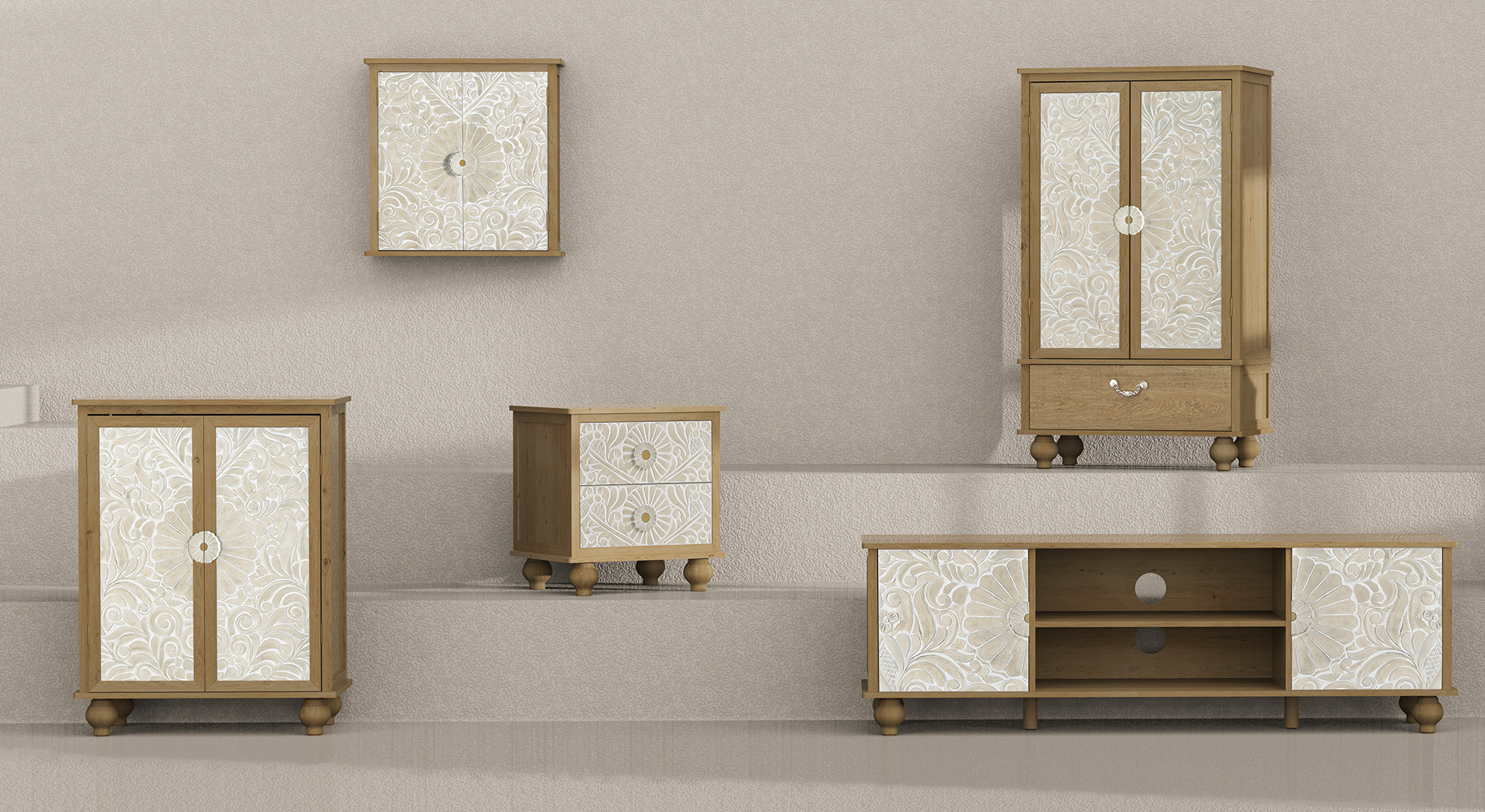
7. Scaling from Pilot Run to Mass Production
A professional entertainment center ODM contract typically
follows four phases:
Phase 0 – Design freeze: 3D drawings, BOM, and assembly
instructions signed off.
Phase 1 – Pilot (25-50 units): Used for real-world assembly
trials and installer feedback. Any modifications are documented via engineering
change orders (ECO).
Phase 2 – Pre-production (200 units): Run at target cycle
time. First-article inspection reports submitted to client.
Phase 3 – Mass production: With statistical process control
charts for every CNC cell and edgebander.
Tooling for custom injection-molded parts (cable grommets, corner brackets)
takes 25-30 days. Soft tooling (aluminum) is recommended for pilot runs;
hardened steel tools for annual volumes above 5,000 units. Explore an entertainment center ODM case study
here with timeline and cost breakdown.
Frequently Asked Questions (B2B Entertainment Center ODM)
Q1: What design files are required to start an ODM project for media
cabinets?
A1: At minimum, provide 2D elevation drawings with
critical dimensions (width, depth, height), required aperture sizes for
electronics, and any preference for wood species or laminate finish. A mood
board or reference images speeds up concept generation. The ODM engineer will
then produce a 3D STEP file and renderings within 10 workdays.
Q2: Can an ODM partner modify an existing catalog design to create an
exclusive collection?
A2: Yes. Most ODM suppliers offer “catalog
modification” — you select a base model, then change materials, dimensions,
finish, or hardware. The resulting technical package becomes your intellectual
property after NDA and tooling payment. This lowers development cost compared to
a ground-up design.
Q3: How does lead time differ between OEM and ODM for entertainment
centers?
A3: Pure OEM (building your existing drawings) typically
takes 45–60 days from confirmation. ODM, which includes design validation and
prototyping, averages 70–90 days for the first order. Subsequent reorders follow
OEM lead times because tooling and processes are established.
Q4: What electrical certifications should an ODM factory hold for
powered entertainment centers?
A4: For North America, UL 962 or CSA
C22.2 No. 308. For Europe, EN 62368-1 (audio/video equipment) plus CE marking.
The ODM provider must subcontract testing to an accredited lab; ask for test
reports with your specific model number. Essent
Home coordinates these certifications as part of the project
scope.
Q5: How is design exclusivity enforced after ODM production
ends?
A5: A legally binding ODM agreement includes a 3-5 year
exclusivity clause preventing the manufacturer from selling your design to third
parties. Some buyers also retain CAD files and restrict the factory’s use of
injection molds. After the exclusivity period, designs may revert to the
factory’s standard catalog unless renewed.
Q6: What is the minimum order quantity (MOQ) for custom entertainment
center ODM?
A6: MOQ varies with complexity. For a custom color and
fabric-wrapped panels, 150 units is typical. For structural redesign (e.g., new
CNC routing program and packaging), 250–300 units. Lower MOQs (down to 50 units)
are possible for surface-only changes (laminate or paint) — though unit price
increases due to setup costs.
Inquiry & Project Consultation
To evaluate whether entertainment center ODM fits your
portfolio requirements, submit an RFQ containing target annual volume, preferred
delivery region, and any existing design references. The engineering team at https://essentfurniture.com/ responds
within two business days with a non-disclosure agreement and preliminary
technical questionnaire. Shortlisted clients receive a sample material booklet
and a virtual tour of the ISO 9001:2015 facility. Request a cost benchmark
against your current sourcing partner — including tooling amortization and
compliance testing fees.
Click here to start an ODM inquiry → Direct supplier evaluation
form (Confidential, no obligation).