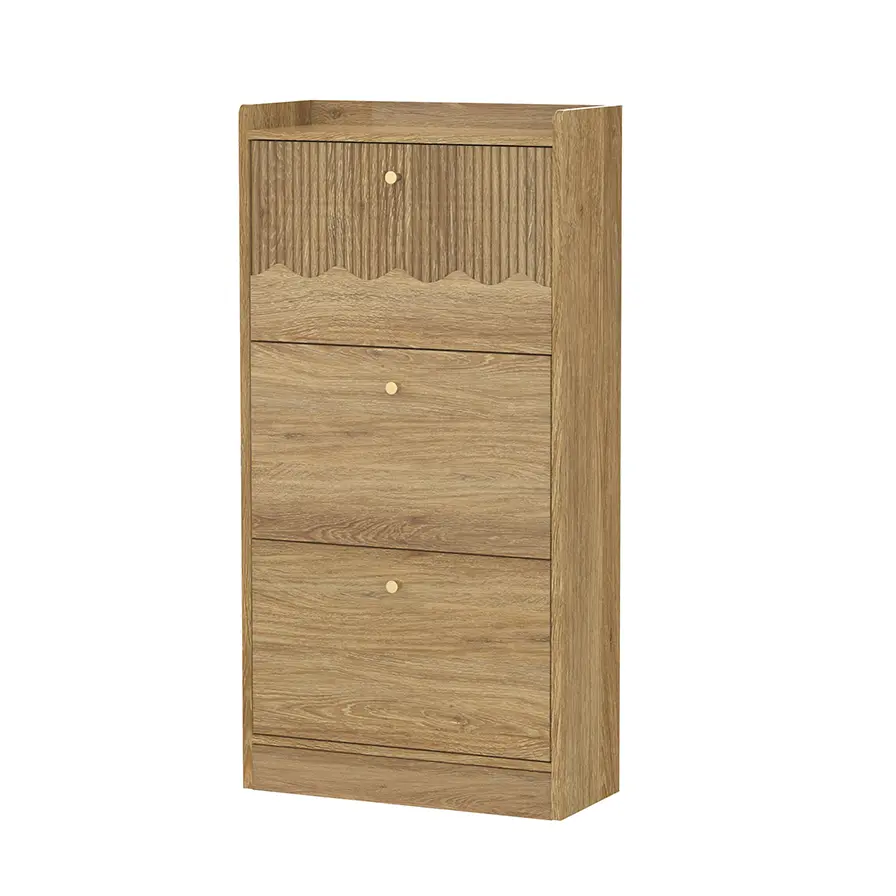
For procurement managers, interior designers, and developers of luxury
apartments, hotels, and senior living communities, the entryway is the first
touchpoint of a building’s spatial narrative. Yet, the functional component that
often becomes a logistical pain point is shoe storage. Specifying a reliable
entryway shoe storage supplier demands rigorous
evaluation beyond catalog aesthetics. This guide outlines eight engineering,
compliance, and supply-chain benchmarks to qualify vendors that deliver
durability, volumetric efficiency, and long-term value in commercial
environments.
1. Material Science & Surface Durability for High-Traffic Zones
Entryways in multi-family housing or hospitality settings face abrasion from
dirt, moisture, and impact. A competent entryway shoe storage supplier must provide
documented performance data for substrates and coatings. Key aspects
include:
Core materials: Baltic birch plywood (15+ layers) resists
warping better than MDF in humid corridors. For high-moisture zones, HPL
(high-pressure laminate) or aluminum frames with powder coating are
preferred.
Scratch & stain resistance: Look for finishes exceeding
4H pencil hardness (ASTM D3363) and resistance to common chemicals like ethanol
or coffee (EN 12720).
Antimicrobial options: Silver-ion impregnated surfaces or
copper-infused laminates reduce bacteria transfer – critical for healthcare or
daycare facilities.
Top-tier suppliers offer third-party test reports for cyclic humidity (ASTM
D2247) and accelerated UV aging. Without these, the risk of delamination or
fading within 18 months increases considerably.
2. Space-Efficient Mechanisms & Volumetric Density
Corridor real estate is costly. commercial buyers need an entryway shoe storage supplier that maximizes pairs
per square foot. Evaluate these mechanisms:
Tilt-out drawers: Save 30% depth compared to pull-out
shelves but require robust hinges rated for 50,000 cycles (tested to ANSI/BHMA
A156.9).
Vertical pull-down units: Ideal for narrow alcoves;
gas-spring assisted operation supports loads up to 40 lbs.
Modular stackable cubes: Allow future reconfiguration –
look for dovetail joinery or cam-lock fittings, not plastic clips.
High-density rotating carousels: For very large projects
(300+ units), motorized carousels can store 48 pairs in a 36"x24"
footprint.
Quantify capacity: a well-engineered cabinet stores 18-24 pairs per linear
meter. Request CAD drawings with clearance dimensions to verify against your
floor plans.
3. Commercial Certifications & Compliance Framework
Architects and general contractors increasingly demand certifications. A
qualified entryway shoe storage supplier should
provide proof of:
CARB Phase 2 / TSCA Title VI for low formaldehyde emission
(critical for LEED v4 or WELL projects).
GREENGUARD Gold – ensures VOC levels safe for sensitive
populations (schools, hospitals).
NFPA 701 flame resistance for textiles (if fabric bins are
used).
ISTA 3A transit testing – reduces damage claims during bulk
shipping.
Moreover, check if the supplier holds ISO 9001:2015 for quality management
and FSC chain-of-custody for wood sourcing. These documents save months of
submittal approval delays.
4. Rapid Customization & OEM/ODM Capabilities
Off-the-shelf solutions rarely fit large-scale projects. Advanced entryway shoe storage supplier offer in-house
engineering for custom widths (from 450mm to 2400mm), RAL color matching, and
integrated accessories like USB ports or motion-sensor lighting. For
brand-conscious developers, logo debossing on drawer fronts or laser-engraved
nameplates provide differentiation.
Key questions to ask potential partners:
What is your typical lead time for a 200-unit custom order (including
prototype approval)?
Do you provide 3D renderings and shop drawings within 5 business days of
deposit?
Can you accommodate railings, cat-proof mesh, or side ventilation
slots?
Suppliers with their own metal and wood fabrication shops (rather than
outsourcing) offer tighter quality control and faster iteration cycles. One such
example is Essent Home, which combines CNC machining with
hand-finishing for high-mix, low-to-medium volume orders (50–5000 units).
5. Logistics, Packaging & Quick-Ship Programs
Construction schedules are unforgiving. Evaluate an entryway shoe storage supplier on their logistics
KPIs:
Flat-pack vs. assembled: Flat-pack reduces freight costs by
40-60%, but requires on-site assembly labor. Hybrid solutions (pre-assembled
carcass, knockdown doors) balance both.
Palletization standards: Corner protectors, edge banding,
and desiccant packs for ocean freight. Check if they offer fumigation-free
ISPM15 certified pallets for international orders.
Quick-ship inventory: For renovation projects, a supplier
should hold 20% of common SKUs (white, grey, natural oak) in regional warehouses
for 5-day lead times.
Request case studies: ask how they handled a last-minute 300-unit order for a
student housing developer. Their answer reveals crisis management
capability.
6. Lifecycle Cost Analysis & Warranty Terms
Low upfront pricing often leads to higher total cost of ownership (TCO) due
to part failures or finish degradation. Perform a 5-year TCO analysis including
expected replacement rates for hinges, drawer slides, and laminate edges.
Professional suppliers provide:
10-year limited warranty on structural components (joints,
panels).
2-year finish warranty against blistering or cracking under
normal use.
Spare parts availability for at least 7 years after product
discontinuation.
Additionally, ask about their quality control batch sampling (e.g., AQL 1.5
for critical defects). This ensures that the 50th cabinet matches the first.
7. Sustainable Sourcing & Take-Back Programs
ESG criteria now influence B2B procurement. A forward-thinking entryway shoe storage supplier should disclose:
Percentage of recycled content in metal components (post-consumer steel ≥40%
is feasible).
Low-VOC water-based adhesives (no added urea-formaldehyde).
End-of-life take-back: can they refurbish or recycle old shoe cabinets from
your facilities?
For projects seeking BREEAM or LEED points, having an Environmental Product
Declaration (EPD) for the core material is increasingly mandatory. Some
suppliers also offer carbon-neutral shipping via verified offset programs.
8. Digital Integration: BIM Objects & ERP Connectivity
Large-scale commercial projects rely on BIM (Building Information Modeling).
Suppliers that provide Revit families or IFC files for their modular shoe
storage systems save design teams dozens of hours. Further, suppliers with an
ERP system that offers real-time order tracking and API integration with your
inventory management system reduce manual follow-ups.
During the pilot phase, ask for a virtual factory tour and test a sample
batch with non-destructive drop tests. A credible partner will share production
floor webcams or weekly photo reports.
Why Essent Home Meets These Benchmarks
Drawing from 18 years of B2B furniture manufacturing, Essent
Home has executed entryway shoe storage projects for Marriott,
Greystar, and Lendlease. Their in-house lab conducts 100,000-cycle drawer slide
tests and 48-hour salt spray testing on hardware. Essent Home offers a dedicated project manager for each order, from DFM (design for
manufacturing) review to container loading inspection. With their recent
expansion of a 150,000 ft² facility in Vietnam (complementing their China
plant), they now offer dual-origin production to mitigate tariff risks. For
architects needing high-density solutions, their custom shoe storage systems include rotating shoe
trees and ventilated slat walls. Combined with a zero-defects packaging
protocol, they consistently achieve a 0.6% defect rate (well below industry
average of 2.2%).
Frequently Asked Questions (FAQ)
Q1: What minimum order quantity (MOQ) do entryway shoe storage suppliers
typically require for custom sizes?
A1: MOQs vary widely. Suppliers using CNC routers often accept 30-50 units
per custom dimension. For full OEM (unique moldings or extrusions), expect
200-500 units. Essent Home offers hybrid prototyping: 10 units for
design validation before full production.
Q2: How do I address ventilation to prevent odor in high-occupancy entryway
shoe cabinets?
A2: Look for suppliers that integrate passive vents (slotted back panels) or
low-energy piezoelectric fans. Another solution is activated charcoal panels
placed in plinth bases. Ask for antimicrobial coating on interior surfaces –
standard in premium entryway storage solutions from
specialized suppliers.
Q3: Which certifications are mandatory for entryway shoe storage used in EU
hospitality projects?
A3: For EU markets, CE marking under EN 16122:2012 (domestic & contract
storage furniture) is mandatory. Also, reach compliance for chemicals and
formaldehyde class E1 (EN 717-1). Fire rating to EN 13501-1 class B or C
depending on escape routes. Verify that your entryway shoe storage supplier holds current test
reports from notified bodies.
Q4: Can shoe cabinets be integrated with smart building systems? (e.g.,
occupancy sensors)
A4: Yes, some B2B suppliers offer recessed PIR sensors that trigger LED strip
lights when the cabinet door opens. For higher budgets, RFID-enabled lockers
track user access. Request wiring channels pre-cut in the side panels during
manufacturing.
Q5: What is the typical lead time for a 500-unit international order after
approval?
A5: For standard finishes and hardware, lead times range 45-60 days
(including sea freight from Asia). Custom finishes or special mechanisms add
10-15 days. Reputable entryway shoe storage supplier provide weekly
production Gantt charts. Expedited air freight can shorten to 3-4 weeks but
costs roughly 30% more.
Need a technical quote
or a sample unit for testing? Our engineering team provides CAD validation, 3D
mockups, and a full compliance dossier before PO placement. Submit
your RFQ with project dimensions, target density, and finish codes – we
respond within 24 business hours with preliminary material specifications and
landed cost estimates.