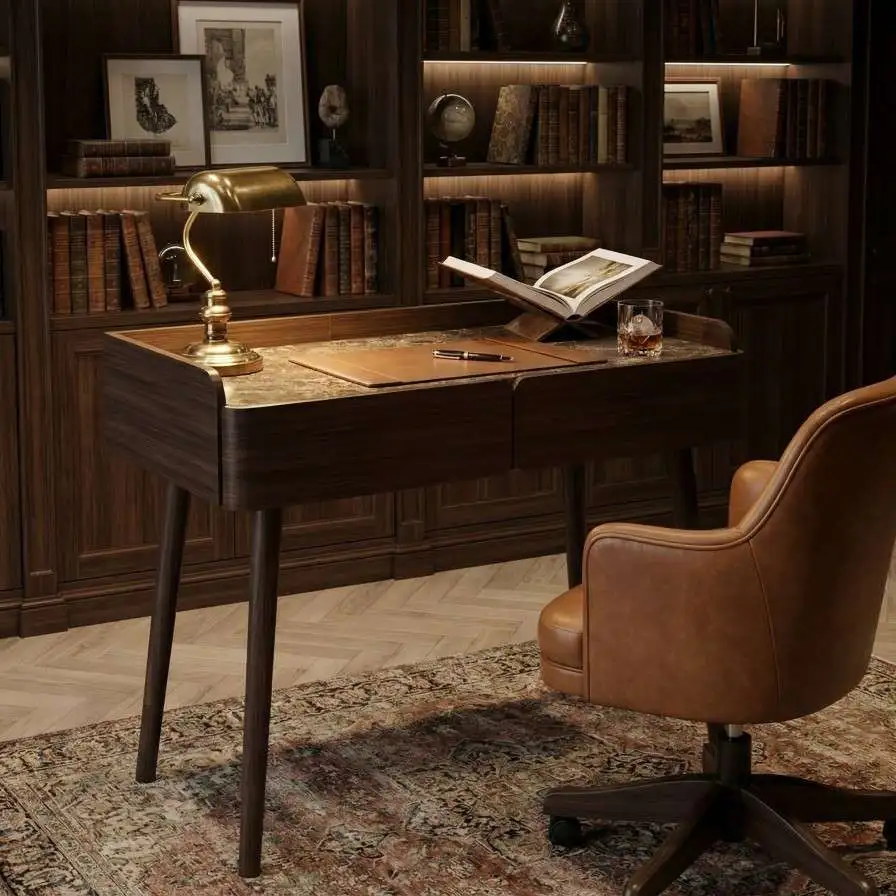
Modern commercial office environments require furniture that balances structural durability with functional storage. Sourcing products at scale involves navigating complex manufacturing processes, material specifications, and quality verification standards. For commercial furniture distributors, hospitality procurement managers, and spatial design firms, identifying a reliable supplier for a desk with drawers oem project involves analyzing production workflows rather than merely reviewing aesthetic designs.
To establish a stable supply chain, buyers must evaluate how manufacturers handle substrate selection, hardware durability, and structural assembly. Commercial-grade furniture manufacturers like Essent Home provide the necessary design-for-manufacturability insights to translate conceptual architectural drawings into robust, mass-produced office furniture assets that meet strict international regulatory standards.
Structural Parameters of Commercial Workstations
A contract-grade desk is subjected to continuous daily stress, requiring a design architecture that prevents sagging, joint separation, and cosmetic degradation. Unlike residential items, commercial desking must withstand varied weight distributions, frequent relocations, and moisture exposure from routine cleaning protocols.
Substrate Integrity and Engineered Wood Selection
The foundation of any high-volume OEM desk lies in the selection of its core substrate. Manufacturers evaluate density, screw-holding capacity, and moisture resistance before allocating materials to a production line:
- Medium-Density Fiberboard (MDF): Featuring a dense, uniform structure, MDF is preferred for desks requiring intricate edge profiling, CNC routing, or high-gloss lacquer finishes. Its smooth surface prevents telegraphing when thin wood veneers are applied.
- Melamine-Faced Chipboard (MFC): Offering high dimensional stability and warp resistance, MFC is highly suitable for large-scale workstation panels. High-density chipboard cores ensure that fasteners remain securely anchored over long periods of use.
- High-Pressure Laminate (HPL) Tops: For high-wear environments, bonding an HPL sheet to an MDF or plywood core provides superior resistance to impact, scratches, and heat.
Environmental compliance is a primary factor in substrate selection. Global procurement demands compliance with low formaldehyde emission standards, such as California Air Resources Board (CARB) Phase 2 or European E1 and E0 standards. These compliance measures ensure indoor air quality in large corporate offices.
Edge Banding Technology
Delamination of edge bands is a frequent point of failure in commercial furniture. Addressing this issue requires utilizing advanced adhesive application systems during the edge banding process. Polyurethane (PUR) adhesive systems are increasingly selected over traditional Ethylene Vinyl Acetate (EVA) hot-melts. PUR adhesives undergo a chemical cross-linking process with atmospheric moisture, creating an ultra-thin, highly water-resistant bond line that prevents moisture penetration and panel swelling along edge joints.
Evaluating Drawer Slide Mechanics and Hardware Systems
The functionality of a desk with drawers oem product is directly determined by its moving components. Hardware specifications dictate the lifespan, load capacity, and user experience of storage-integrated desks.
Drawer Runner Configurations
OEM projects must define runner specifications based on the intended application of the storage unit:
- Ball-Bearing Side Slides: These traditional steel runners offer robust lateral stability and are rated for heavy loads, commonly ranging from 30 kg to 45 kg per drawer. They provide smooth travel but remain visible when the drawer is open.
- Undermount Soft-Close Slides: Positioned beneath the drawer box, these slides remain completely hidden from view, preserving clean aesthetic lines. They feature fluid dampers that prevent slamming, reducing ambient noise in quiet office environments.
- Full-Extension vs. Over-Travel: Commercial file drawers require full-extension runners to grant complete access to files stored at the rear of the drawer box, maximizing spatial efficiency.
Safety and Anti-Tilt Engineering
Multi-drawer pedestals present physical safety hazards if neglected during the design phase. To prevent tipping occurrences when multiple drawers are pulled out simultaneously under load, OEM designs incorporate mechanical interlocking anti-tilt systems. These systems restrict user access to a single open drawer at any given time. When one drawer is pulled forward, a steel cable or rod mechanism locks the remaining runners in place, stabilizing the overall footprint of the desk unit.
Addressing B2B Sourcing Challenges in desk with drawers oem Partnerships
Sourcing customized furniture at scale involves managing production risks, communication gaps, and logistical delays. A structured manufacturing plan is required to move smoothly from initial prototyping to final shipment container loading.
Dimensional variance represents a frequent friction point between design firms and factories. A professional manufacturer employs standardized tolerances, typically keeping deviations within +/- 0.5mm across major panel dimensions. Utilizing automated CNC drilling and cutting centers ensures that holes for dowels, cam locks, and hardware runners align precisely, eliminating assembly difficulties when units are put together on-site.
Supply chain transparency also affects project timelines. Delays in hardware sourcing or veneer matching can disrupt office fit-out schedules. Working with a vertically integrated partner reduces these risks by maintaining raw material buffers and establishing long-term partnerships with certified hardware manufacturers. Understanding how a specialized facility like Essent Home manages these parameters can provide procurement departments with predictable lead times and consistent product performance across various batches.
Product Customization and Component Specifications
Defining the structural requirements of a customized desk with drawers oem requires a clear understanding of hardware, lock setups, and cable management options. Clear documentation prevents delays during the engineering review stage.
| Component Segment | Standard Specification Options | Performance & Compliance Metric |
|---|
| Core Panel Substrate | E0/E1 Grade MDF, High-Density Particleboard | CARB Phase 2 Certified, low VOC emissions |
| Surface Finish | Premium Wood Veneer, Thermo-Fused Melamine (TFM) | Scratch-resistant, chemical cleaning resistance |
| Drawer Mechanism | Undermount soft-close, self-closing ball-bearing | 50,000 continuous cycle lifetime verification |
| Locking Assemblies | Central gang locks, numeric digital keypad locks | High-security key cylinder variations |
| Cable Management | Integrated wire brush grommets, hidden metal trays | Keeps workspace clean and wire-free |
Locking mechanisms require careful planning. Central locking systems use a single key mechanism to secure all drawers in a pedestal unit simultaneously. For shared workspaces, digital keypad locks or RFID lock assemblies can be integrated into the drawer fronts, offering modern keyless access for corporate employees.
Cable management routing must also be considered. If a user intends to house charging stations or personal devices inside a drawer, the drawer box backing must feature ventilation cuts and continuous cord-pass-through channels that do not crimp during runner travel.
Manufacturing QA and Packaging Procedures
Quality assurance is integrated into every phase of production, from raw material receipt to container loading. Wood moisture content is monitored throughout processing; moisture levels are maintained between 8% and 12% to prevent warping, splitting, or joint cracking during sea transit across different climate zones.
Finished goods undergo rigorous packaging design to prevent damage during long-distance shipping and final distribution. Standard packaging methods include:
- Drop-Tested Corner Protectors: High-density expanded polyethylene (EPE) foam guards are placed on all panel corners to absorb impact energy.
- Five-Ply Corrugated Cartons: Heavy-duty double-wall exterior cartons shield contents from punctures and structural compression during stacking.
- Polyester Flat-Strapping: Secure banding prevents shifting of internal wood components within the packaging box.
- IST-3A Testing Compliance: Packaging methods are evaluated using drop and vibration simulation tests to ensure products arrive intact at the destination warehouse.
When defining the requirements for a desk with drawers oem order, procurement teams should request detailed test reports covering load capacity, chemical finish resistance, and hardware endurance. This documentation verifies that the production run meets commercial-use standards.

Establishing a Structured OEM Procurement Process
An organized procurement cycle is necessary for successful commercial furniture manufacturing. The process begins with the submission of CAD files or detailed material sheets, allowing the factorys engineering team to assess the structural integrity of the design. During this review, alternative joinery details or panel configurations may be suggested to improve stability and streamline production efficiency.
Following design approval, physical samples are produced to verify finishing options, hardware action, and assembly clearances. Once the sample is signed off, trial-run manufacturing is scheduled to ensure consistency across the tooling machinery. This structured approach helps prevent bulk production errors and ensures the final batch matches the approved design specifications.
For custom manufacturing projects, the engineering team at Essent Home is prepared to review your plans and provide detailed design-for-manufacturability feedback. Partnering with a specialized manufacturer helps streamline the design-to-production pipeline for your desk with drawers oem program, keeping your project on schedule and in line with quality requirements.
Frequently Asked Questions
Q1: What are the primary substrate differences between MDF and MFC in desk construction?
A1: Medium-Density Fiberboard (MDF) consists of fine wood fibers bonded with resins, offering a dense, uniform structure ideal for shaped profiles, routing, and high-gloss lacquer finishes. Melamine-Faced Chipboard (MFC) is made from bonded wood chips covered with a decorative melamine paper, providing high dimensional stability and warp resistance for flat structural panels.
Q2: Why is PUR adhesive preferred over EVA for commercial edge banding?
A2: PUR (Polyurethane) adhesive reacts with atmospheric moisture to form a strong chemical cross-link. This creates a highly water- and heat-resistant bond with a thin, near-invisible glue line. Standard EVA (Ethylene Vinyl Acetate) is a hot-melt adhesive that can soften under high temperatures and is more susceptible to water penetration over time.
Q3: How does an anti-tilt mechanism work in multi-drawer pedestals?
A3: An anti-tilt mechanism is a safety system that prevents more than one drawer from opening at a time. Pulling a drawer open engages a mechanical rod or cable system that locks the remaining runners, keeping the desk unit stable and preventing tipping hazards.
Q4: What testing standards apply to OEM office desks?
A4: Commercial office desks are typically evaluated under standards such as ANSI/BIFMA X5.5 for desk products or European standard EN 527. These include tests for structural load capacity, stability, leg strength, and runner cycle life (often 50,000 cycles under load) to ensure safety in contract environments.
Q5: Can OEM desks be configured with digital locking systems?
A5: Yes. OEM manufacturing allows for the integration of digital keypad locks, mechanical combination locks, or RFID electronic lock systems. These options are integrated during drawer front machining to ensure clean aesthetics and reliable security.
Project Consultations and Custom OEM Inquiries
For detailed project consultations, volume custom manufacturing inquiries, or to submit your detailed RFQ and CAD drawings, please contact our contract sales division. Our engineering team will review your specifications, material needs, and volume schedules to provide a comprehensive manufacturing proposal.