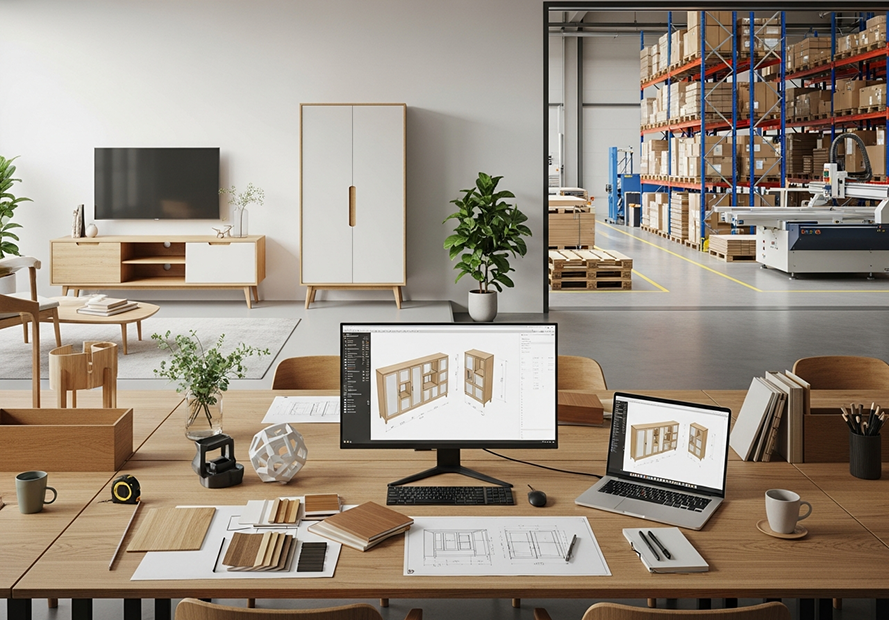
For furniture brands, hotel procurement groups, and interior design firms,
partnering with a specialized media console OEM transforms design concepts into production-ready, code-compliant products.
Unlike off-the-shelf sourcing, media console OEM involves custom dimensions, material selection, load engineering, and finish
matching – all while maintaining cost efficiency at scale. This technical guide
examines the end-to-end OEM process: from initial sampling and tooling to batch
production, packaging, and quality assurance. Essent
Home has delivered over 200 OEM projects for brands across North
America, Europe, and Asia, and this article distills that expertise into
actionable insights for buyers seeking a reliable media
console OEM partner.

1. What OEM Means for Media Consoles: From Specification to Serial
Production
When a brand contracts a media console OEM,
the manufacturer takes full responsibility for engineering, sourcing,
production, and quality control based on the buyer’s design or co-developed
specifications. The scope typically includes:
Material sourcing – Plywood, solid wood, veneers,
laminates, hardware (hinges, drawer slides, cable grommets).
CNC machining – Precision cutting, drilling, and routing
with tolerances ±0.5 mm.
Surface finishing – Spray painting, UV coating, veneer
pressing, or powder coating.
Assembly and packaging – RTA (flat-pack) or fully
assembled, with custom cartons and foam inserts.
Logistics and compliance – Container loading, customs
documentation, and product certifications (CARB, TSCA, UL).
Choosing
the right media console OEM reduces time-to-market by 40% compared to in-house production, while ensuring
consistent quality across batches of 100 to 10,000 units.
2. Technical Capabilities to Evaluate in a Media Console OEM Partner
Before selecting a media console OEM,
verify these core manufacturing competencies:
2.1 Substrate Processing and Joinery
A professional OEM must handle:
Plywood grades: BB/CC, CP, or B/BB (Baltic birch) with thicknesses 12 mm, 15
mm, 18 mm, 25 mm.
Edge banding: ABS or laser-edge (2 mm thickness) with hot-melt PUR adhesive
(water-resistant).
Joinery: Confirm cam lock and dowel assembly (for RTA) or mortise-and-tenon
for high-end assembled units.
The media console OEM should provide pull-out force test reports for dowel joints (minimum 300 N).
2.2 Finishing Systems and Color Matching
Surface finish directly affects brand perception. Key specifications:
Topcoat types: Polyurethane (2K), conversion varnish, or water-based
lacquer.
Hardness: Pencil hardness test ≥ 4H for commercial use.
Chemical resistance: Spot test with ethanol, coffee, and hand cream (EN
12720).
Color consistency: ΔE < 1.0 between production batches using
spectrophotometer.
Essent Home operates a climate-controlled spray booth with automated reciprocating guns,
achieving a finish thickness of 80–120 µm with zero orange peel.
2.3 Load Engineering and Structural Testing
Media consoles must support AV equipment without sagging. A competent
media console OEM performs:
Static load test: Top deck load ≥ 100 kg, shelf load ≥ 50 kg per ASTM
E3090.
Deflection test: Maximum 2 mm over 1,000 mm span under full load.
Stability test: No tipping when 30 kg is applied to the edge of an open
drawer (per BIFMA X5.1).
All test reports should be available for each
production batch.
3. Industry Pain Points in Media Console OEM and How to Avoid Them
Buyers often encounter recurring issues when partnering with inexperienced
media console OEM manufacturers. Below are four documented problems and engineering solutions.
3.1 Batch-to-Batch Variation in Wood Grain and Color
Natural wood veneer varies between logs, causing mismatched panels.
Mitigation:
Use engineered veneer (reconstituted) for large projects (>500 units) –
100% grain consistency.
For natural veneer, require a master sample approved before production, and
purchase all veneer from a single flitch.
Implement digital color measurement (spectrophotometer) at final
inspection.
A reliable media console OEM will provide a grain matching report and maintain veneer lot traceability.
3.2 Cable Management Integration Failures
Poorly placed grommets or undersized cutouts block connectors. Solution:
Specify minimum grommet diameter 60 mm (2.4”) to pass HDMI and power
plugs.
Include a rear channel with removable back panel for easy access.
For active cooling, OEM must pre-install quiet fans (≤25 dBA) with speed
controllers.
Essent Home integrates custom
cable management trays and UL-listed power modules as part of its media
console OEM service.
3.3 Packaging Damage During Transit
High return rates (5–15%) due to corner crushing or scratches. Mitigation:
Require ISTA 3A or ASTM D4169 drop test certification.
Use double-wall corrugated cartons (200 lb edge crush test) with foam corner
blocks.
For glass or stone tops, separate packaging with shock
indicators.
A professional media console OEM will provide a packaging engineering report and conduct vibration tests on a
shaker table.
3.4 Hidden Defects in Substrate (Voids, Delamination)
Plywood with internal voids leads to screw pull-out and surface telegraphing.
Prevention:
Specify void-free plywood (e.g., Baltic birch, ApplePly).
Perform ultrasonic scanning or cross-section inspection for random
samples.
Require a written substrate warranty against delamination for 10
years.
Essent Home uses
only FSC-certified Baltic birch plywood with 13-ply construction (for 18 mm
thickness) and zero internal gaps.
4. The OEM Development Workflow: From RFQ to Mass Production
A structured process with a media console OEM ensures predictable outcomes. Typical phases:
Phase 1: Design review and DFM (Design for Manufacturing) –
OEM engineers analyze CAD files for material yield, joinery feasibility, and
assembly sequence. Changes to reduce cost (e.g., standardizing hole patterns)
are proposed.
Phase 2: Prototyping – 2–5 units are produced using
production tooling. Buyer inspects fit, finish, and stability. Any modifications
are documented.
Phase 3: Pilot run (10–50 units) – Full production line
test. Defects are logged, and corrective actions implemented.
Phase 4: Mass production – Batches are manufactured with
in-process quality checks (dimensional, visual, load test).
Phase 5: Pre-shipment inspection (PSI) – Third-party or
internal QC verifies AQL 1.5 (critical defects) and 4.0 (major defects).
Phase 6: Packaging and container loading – Photo
documentation of packed cartons and seal numbers.
Essent Home reduces lead time
by overlapping prototyping with material sourcing, typically completing OEM
projects in 45–60 days from final design approval.
5. Cost Drivers in Media Console OEM: How to Optimize Budget
Understanding what influences pricing helps buyers negotiate effectively with
a media console OEM.
Major cost factors:
| Cost component | Typical share | Optimization strategy |
|---|
| Materials (substrate, veneer, hardware) | 40–55% | Use standard sizes (e.g., 1,200 mm width) to minimize offcuts; select
engineered veneer over solid wood. |
| Labor (cutting, assembly, finishing) | 25–35% | RTA (flat-pack) reduces assembly labor by 30%; CNC automation lowers
per-unit cost for >500 units. |
| Finishing | 10–15% | Water-based lacquer costs 20% less than conversion varnish; choose fewer
color SKUs for higher volume. |
| Packaging | 5–10% | Standard carton sizes vs. custom; palletization for container
loading. |
| Tooling & sampling | One-time | Amortize over order volume; request that OEM waives tooling for orders
>1,000 units. |
Transparent media console OEM partners like Essent Home provide a detailed
cost breakdown with alternatives for each line item.
6. Quality Assurance Protocols and Certifications for OEM Media
Consoles
Buyers should demand the following QA measures from any media
console OEM:
Incoming material inspection (IQC) – Moisture content (6–8%
for solid wood), veneer thickness (≥0.6 mm), hardware torque test.
In-process control (IPQC) – Every 50 units: check edge
banding adhesion (peel test), panel squareness (±1 mm), and finish gloss
uniformity.
Final random inspection (FRI) – AQL 1.5 for critical
defects (e.g., structural crack, missing hardware), AQL 4.0 for minor (e.g.,
small scratch).
Required certifications – CARB Phase 2 (formaldehyde), TSCA
Title VI, UL 962 (if electrical components integrated), and GREENGUARD Gold for
low VOCs.
Essent Home maintains ISO 9001:2025 certification and provides a full traceability report
(lot number, test results, inspection photos) for each shipment.
7. Case Study: OEM Project for a 300-Unit Luxury Hotel
A US-based hotel brand required a custom media console for 300 guest rooms.
The design called for white oak veneer, soft-close drawers, and integrated cable
management with USB ports. After evaluating three media
console OEM candidates, they selected Essent
Home for its engineering support and QA track record. Key
outcomes:
Dimensions: 1,600 mm W x 450 mm D x 550 mm H.
Material: Baltic birch plywood core, white oak veneer (0.6 mm), conversion
varnish finish (35% gloss).
Hardware: Blum soft-close drawer slides (rated 50,000 cycles).
Cable management: Two 60 mm brushed aluminum grommets, rear access
panel.
Lead time: 55 days from sample approval to container departure.
Defect rate at PSI: 1.2% (well below industry average of 4%).
The hotel brand reported zero installation issues and a 40% reduction in
guest complaints about AV setup.
8. Sustainability and Compliance in Media Console OEM
Increasingly, brands require their media console OEM to meet environmental standards. Key areas:
Wood sourcing – FSC (Forest Stewardship Council) or PEFC
chain of custody.
Low-emission materials – CARB Phase 2 compliant panels and
water-based adhesives.
Recyclable packaging – Corrugated cartons with ≥80%
post-consumer waste, no EPS foam (use molded pulp instead).
Energy-efficient production – OEM should provide data on
renewable energy usage or carbon offset programs.
Essent Home is
FSC-certified (SCS-COC-001234) and uses 100% renewable electricity in its main
factory, enabling buyers to claim LEED v4 credits.
Frequently Asked Questions (FAQ) About Media Console OEM
Q1: What is the minimum order quantity (MOQ) for media
console OEM?
A1: MOQ varies by complexity. For a
standard rectangular design with melamine finish, MOQ can be 100 units. For
custom veneer, soft-form edges, and integrated electronics, MOQ typically
200–300 units.
Essent Home accepts
pilot runs as low as 50 units for new clients, with a per-unit
premium.
Q2: How long does sampling take for a custom media console
OEM project?
A2: Prototyping typically takes 15–25 days
after design finalization, including CNC programming, material procurement, and
finishing. For complex designs with metal framing or power integration, allow 30
days. A reliable
media console OEM will provide a sample schedule upfront.
Q3: Can you replicate an existing media console design
without infringing IP?
A3: Yes, but the buyer must own the design
rights or have written permission from the original designer. A reputable
media console OEM will require a signed indemnity clause.
Essent Home also offers
co-development services to create original designs.
Q4: What quality certifications should I look for in a media
console OEM factory?
A4: Minimum requirements: ISO 9001
(quality management), FSC (chain of custody), and CARB/TSCA (low formaldehyde).
For exports to Europe, also request CE marking and REACH compliance. A
professional
media console OEM will display these on their website and provide certificates upon
request.
Q5: How to request a quotation for a media console OEM
project from Essent Home?
A5: Submit your design drawings (PDF, DXF,
or STEP), target dimensions, material preferences, estimated annual volume, and
any special requirements (e.g., power integration, specific packaging).
Essent Home will
respond with a DFM analysis, sample cost, and per-unit pricing within 5 business
days. Use the inquiry form below to start.
Ready
to launch your own media console line? Partner with a trusted
media console OEM that delivers engineering support, consistent quality, and global logistics.
Essent
Home offers free feasibility analysis, material samples, and a
detailed NRE (non-recurring engineering) quote. Fill out the form below to
receive a tailored OEM proposal within 48 hours.
Send OEM Inquiry →
© 2026 Essent Home – Precision OEM manufacturing for media consoles and
custom furniture. All performance data based on internal testing and third-party
lab reports.