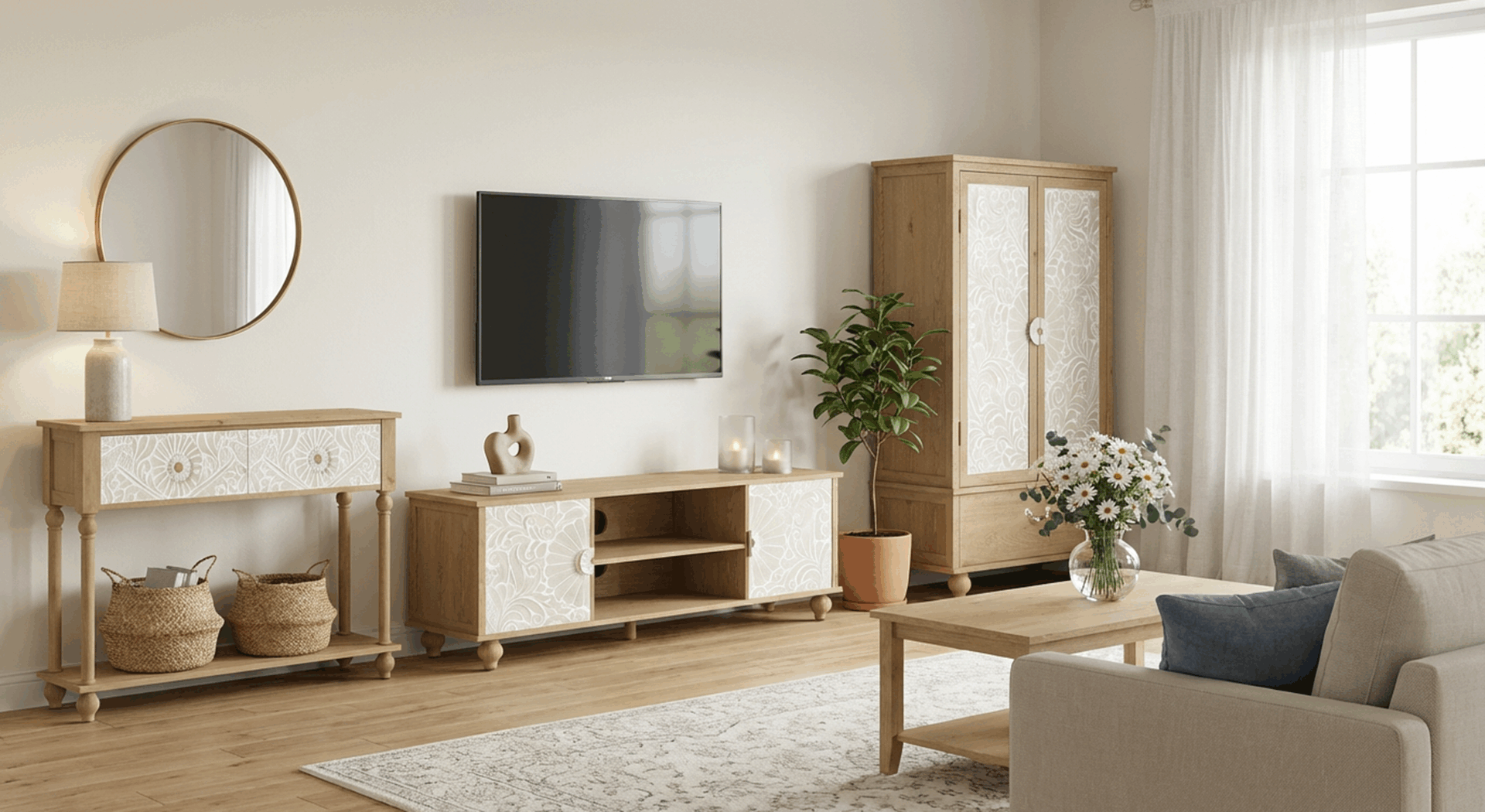
For interior design brands, e-commerce retailers, and contract furnishing
suppliers, launching a distinctive media console requires more than a sketch.
Original Design Manufacturing (ODM) partnerships transform product concepts into
production-ready, market-validated units. A reliable media
console odm partner provides end-to-end services: industrial design
refinement, material sourcing, structural engineering, prototyping, mass
production, and quality assurance. This article examines the technical depth
required in modern media console ODM, including joinery methods, finish
durability, cable integration, and compliance with global safety standards.
Drawing from Essent
Home project data across North American and European
clients, we address common brand pain points and provide engineering solutions
for scalable, defect-free production.
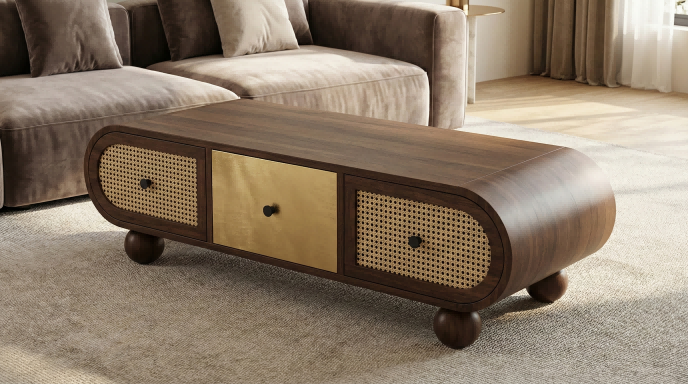
1. Defining Media Console ODM: Beyond White-Label Manufacturing
ODM differs from OEM (Original Equipment Manufacturer). In an OEM
arrangement, the brand provides a complete design and the factory produces
strictly to specifications. In a media console odm partnership, the manufacturer takes ownership of the design and engineering
process, offering pre-developed platforms or co-developing new models based on
the brand’s target price point, aesthetic direction, and functional
requirements. Key services included in a full ODM engagement:
Industrial design – 2D/3D concept development, material
selection (solid wood, veneers, MDF, metal, glass), and hardware specification
(hinges, drawer slides, levelers).
Structural engineering – Finite element analysis for
load-bearing shelves, anti-tip brackets, and flat-pack assembly
optimization.
Prototyping and testing – Build 3–5 prototypes for fit,
finish, and function; perform ISTA transit tests and BIFMA durability
cycles.
Production tooling – CNC nesting files, edgebanding
programs, drilling jigs, and packaging die-cuts.
Quality control – In-line inspection (dimensional, color,
scratch) and statistical process control for batch consistency.
For brands without in-house engineering teams, a competent media
console odm partner reduces time-to-market by 40–60% compared to
developing from scratch. Essent Home maintains a library of 150+ pre-engineered media console platforms that can be
customized with alternative veneers, hardware finishes, or dimensions – a
typical development cycle runs 8–12 weeks to first shipment.
2. Critical Design Parameters for Media Console ODM Projects
Engineering a media console for ODM production involves balancing aesthetics,
functionality, and manufacturability. The following parameters must be defined
early:
Overall dimensions – Width: 1200–2400 mm (48–96 inches);
depth: 350–500 mm (14–20 inches); height: 450–650 mm (18–26 inches). Deeper
consoles allow larger AV components but increase packaging volume and shipping
cost.
Weight capacity – Top surface: minimum 50 kg evenly
distributed; each shelf: 15–25 kg. Structural reinforcement (corner blocks,
metal brackets) required for solid wood tops.
Cable management – Integrated pass-through holes (50–80 mm
diameter) with grommets, rear cutouts for power strips, and internal raceways to
hide wires. Open-back designs simplify access but require careful dust
management.
Ventilation – For enclosed compartments housing AV
receivers or game consoles, slotted doors or perforated back panels are
mandatory to prevent overheating. Minimum 20% open area for compartments with
active electronics.
Assembly method – Ready-to-assemble (RTA) using cam locks
and dowels vs. pre-assembled. RTA reduces shipping volume by 30–50% but requires
clear instruction design and higher part tolerance.
Essent Home engineers use CAD with integrated tolerance analysis to ensure that cam lock
alignments remain within 0.2 mm across different production batches – a critical
factor for RTA customer satisfaction. For a recent media
console odm project for a Scandinavian brand, the team developed a
1600 mm console with hidden cable ducts and soft-close drawers, achieving a
98.5% first-pass yield in mass production.
3. Material Selection and Finish Engineering for Durability
Media consoles face daily use: hot coffee cups, spilled liquids, AV equipment
vibration, and UV exposure near windows. Material and finish choices directly
impact warranty claims. Common material combinations in media
console odm projects:
Solid hardwood – Oak, walnut, ash, or rubberwood. Provides
natural grain and repairability. However, solid wood requires moisture content
control (6–8%) to prevent warping. Kiln-dried lumber with stress-relief cycles
is mandatory.
Veneered engineered wood – MDF or plywood core with real
wood veneer (0.5–0.6 mm thickness). More stable than solid wood, allows
book-matching or slip-matching for continuous grain patterns. Veneer must be
hot-pressed with urea-formaldehyde or PVA adhesives for bond strength.
High-gloss lacquer – Polyurethane or polyester coatings on
MDF. Requires a sealed primer, base coat, color coat, and clear topcoat (minimum
3 layers). Gloss levels: 70–90 GU. Surface hardness ≥2H pencil hardness to
resist scratching.
Metal components – Powder-coated steel legs or frames.
Coating thickness 60–80 µm, salt spray resistance 120+ hours (ASTM B117).
Stainless steel (grade 304) for brushed or mirror finishes.
Glass doors – Tempered safety glass (4–6 mm thickness) with
sandblasted or frosted patterns. Edge grinding to C-shape for safety.
Finish testing protocols for media console odm should include: cross-cut adhesion (ASTM D3359), abrasion resistance (Taber
test, 200 cycles), chemical resistance (ethanol, coffee, 10% acetic acid), and
UV discoloration (QUV 200 hours). Essent Home operates an in-house finish lab; a recent walnut veneer console passed 500
cycles of abrasion with no visible wear, exceeding industry standards.
4. Common Industry Pain Points and ODM Solutions
Brands that source media consoles from multiple factories often encounter
recurring problems. Below are typical issues and how a professional media
console odm partner resolves them:
Inconsistent color matching across production batches –
Cause: manual stain application or non-calibrated spray equipment. Solution:
digital color management (spectrophotometer with ΔE<1.5), automated spray
robots, and wet film thickness gauges. Essent Home maintains a master panel for
each finish, checked every shift.
Drawer misalignment and sticky slides – Cause: inconsistent
drawer box dimensions or low-quality slides. Solution: CNC-cut drawer components
with tolerance ±0.15 mm, and use full-extension soft-close slides (rated 30,000
cycles). Pre-assembly jigs ensure squareness.
Damage during transit – Cause: insufficient packaging
design. Solution: ISTA 3A or 6A testing to determine required edge protectors,
corner blocks, and foam density. For a media console ODM shipping to US
e-commerce customers, Essent Home designed a double-wall carton with EPS foam
inserts, reducing damage claims from 8% to 1.2%.
Difficulty in assembly (RTA products) – Cause: poor
instruction design or ambiguous part labeling. Solution: 3D step-by-step
instructions with QR code linking to video; color-coded cam locks and dowels;
and self-centering pilot holes. Essent Home uses augmented reality (AR) assembly
guides for selected ODM projects.
5. Quality Assurance Protocols for Media Console ODM Shipments
A robust quality management system (QMS) is non-negotiable. For each
media console odm production run, the following inspection stages are recommended:
Incoming material inspection – Check board thickness,
moisture content, veneer grain direction, hardware plating adhesion.
In-process inspection (IPQC) – Every 50 units: dimensional
check (width, depth, height, diagonal), edgebanding adhesion (pull test 1 kg
force), drawer slide operation, and surface scratch check under 1000 lux
lighting.
Final random inspection (AQL 2.5/4.0) – Assemble 2–3 units
per batch completely; verify all parts present, hardware functions, stability,
and cosmetic defects per ANSI/SOHO standards.
Pre-shipment vibration test – Random vibration for 60
minutes to simulate truck transport, followed by visual inspection.
Essent
Home provides clients with a digital quality report for
each container, including photos of critical checkpoints and measurement data.
For a recent media console ODM order of 2,000 units, the final AQL inspection
showed zero major defects and only 1.2% minor defects (mostly packaging scuffs),
well below industry average.

6. Logistics, Lead Times, and Minimum Order Quantities for ODM Projects
Understanding supply chain economics helps brands plan inventory and cash
flow. Typical parameters for media console odm engagements:
Minimum order quantity (MOQ) – For custom designs (new
tooling, unique finish): 300–500 units per color/size. For existing platforms
with minor modifications: 100–200 units. Higher MOQs reduce per-unit cost
(economies of scale).
Lead time – Prototyping: 4–6 weeks; tooling and sampling:
2–3 weeks; mass production: 30–45 days after deposit; sea freight (Asia to US
West Coast): 18–22 days; plus customs clearance (3–7 days). Total lead time from
order to warehouse: 12–16 weeks.
Cost breakdown – Raw materials 40–50%, manufacturing labor
15–20%, finishing 10–15%, hardware 5–10%, packaging 5–8%, overhead and profit
10–15%.
Payment terms – Typical 30% deposit, 70% against bill of
lading. For repeat clients, net 30 days after shipment may be
available.
Essent
Home operates a vertically integrated factory with
in-house veneer processing, CNC machining, and finishing lines. This reduces
dependency on external suppliers and allows MOQs as low as 50 units for existing
platform modifications – ideal for boutique brands testing new collections.
7. Frequently Asked Questions About Media Console ODM
Q1: What is the difference between media console ODM and OEM? Which is
better for a new furniture brand?
A1: OEM means the brand provides a complete design and the factory produces
to exact drawings – suitable for brands with strong in-house engineering. ODM
means the factory provides design, engineering, and production – better for
brands without technical staff or those wanting faster market entry. For most
startup and mid-sized brands, a media console odm partnership reduces risk because the manufacturer has already solved common
engineering problems (joint strength, flat-pack tolerances, finish durability).
Essent Home offers both models; first-time furniture brands typically start with
ODM using our existing platforms.
Q2: How do I protect my unique design when working with an ODM partner?
A2: Sign a non-disclosure agreement (NDA) and a non-compete clause that
prevents the ODM from selling your exact design to other brands. However, note
that ODM factories own the underlying engineering (tooling, CNC programs). For
true exclusivity, you can pay for dedicated tooling (molds, jigs) that remains
your property. Many brands combine a unique finish or hardware combination with
a standard ODM silhouette – this is easier to protect via design patents. Essent
Home honors confidentiality and has produced exclusive collections for 20+
brands without leakage.
Q3: What certifications should an ODM media console have for sale in North
America and Europe?
A3: For North America: CARB Phase 2 or TSCA Title VI for composite wood
formaldehyde emissions; BIFMA X5.1 for safety and durability (stability, load
tests); and UL 962 for electrical components if the console includes integrated
power outlets or lighting. For Europe: CE marking with EN 16122 (strength and
stability) and EN 717-1 for formaldehyde. Essent Home provides all required test
reports and can advise on jurisdiction-specific requirements.
Q4: Can an ODM partner help with packaging design for e-commerce
direct-to-consumer (DTC) shipping?
A4: Yes. Professional ODM services include packaging engineering. Key
considerations: box size optimization to avoid dimensional weight surcharges;
corner protection; foam or honeycomb inserts; and labeling for assembly
sequence. Essent Home designs packaging that passes ISTA 3A (standard for
e-commerce parcels). We also produce instruction sheets and QR codes to video
assembly guides – critical for reducing DTC returns.
Q5: What is the typical warranty period for an ODM media console, and how
are claims handled?
A5: Most ODM contracts offer a 1-year structural warranty (defects in
materials or workmanship) and a 2-year finish warranty (blistering, peeling).
For claims, the brand collects photos and batch numbers; the ODM provides
replacement parts (doors, panels, hardware) FOB factory. Shipping cost for
replacement parts is typically shared. Essent Home maintains a spare parts
inventory for 3 years after production ends. For a recent media console ODM
project, the warranty claim rate was 0.8% – mainly damaged glass doors during
transit.
Q6: How does the ODM process handle custom finishes, such as specific
Pantone colors or multi-step lacquer?
A6: The process begins with a color sample (e.g., a Pantone chip or a
physical sample). The ODM lab creates 3–5 spray-out panels, which the client
approves. Then a pilot run of 10–20 units is produced and shipped for final
sign-off. For multi-step finishes (e.g., stain + glaze + topcoat), the ODM
documents each layer's application parameters (viscosity, drying time, sanding
grit). Essent Home has a dedicated color-matching spectrophotometer and can
match any solid color or transparent stain within ΔE<1.5.
8. Conclusion and Partnership Recommendation
Selecting the right media console odm partner is a strategic decision that affects product quality, brand reputation,
and supply chain efficiency. Brands should evaluate ODM candidates based on
engineering capability, material traceability, quality control processes, and
logistics transparency. A partner that offers in-house prototyping, finish
testing, and packaging design reduces the number of external vendors and
simplifies project management.
Essent
Home provides full-service media console ODM from concept
to container loading. Our portfolio includes modern, mid-century, industrial,
and Scandinavian styles – all engineered for flat-pack or pre-assembled
delivery. We invite furniture brands to review our existing platforms or discuss
a custom development program.
Ready
to launch your media console collection? Send an inquiry with your target
dimensions, style direction, estimated annual volume, and target price points.
Our product development team will respond within 3 business days with a
preliminary proposal, sample photos of similar projects, and a rough
timeline.
Submit your media console ODM
inquiry →
Or contact directly: ceciliahuang@essenthome.com– reference “Media
Console ODM Technical Guide” for priority engineering consultation.