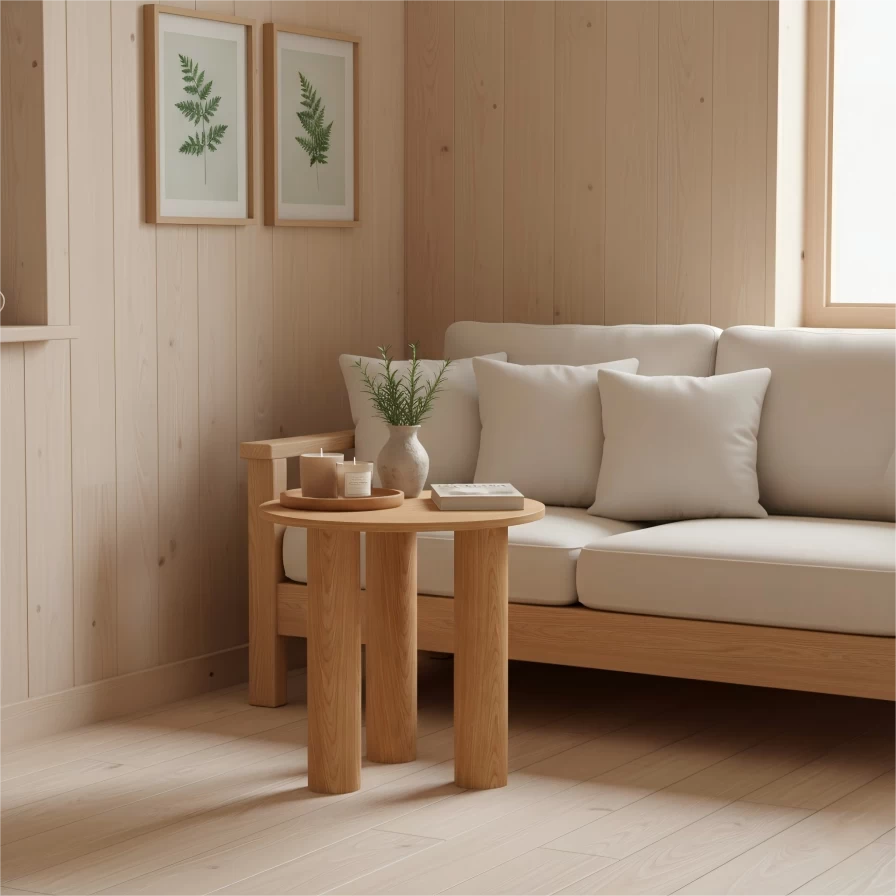
For a retail buyer, the product is also a logistics item. Carton size, assembly time, finish durability, and damage rate decide whether the table makes money after freight and returns.
This guide covers the seven specifications to lock before sampling, the material trade-offs, and the checks that separate a repeatable program from a one-off sample.
Essent is a custom furniture manufacturer for retail brands, with OEM/ODM programs for living room, dining, bedroom, and entryway furniture. If you are developing an accent table, send the target price, channel, and room scene early. A short brief gets you a buildable specification and a quotation instead of a generic catalog.
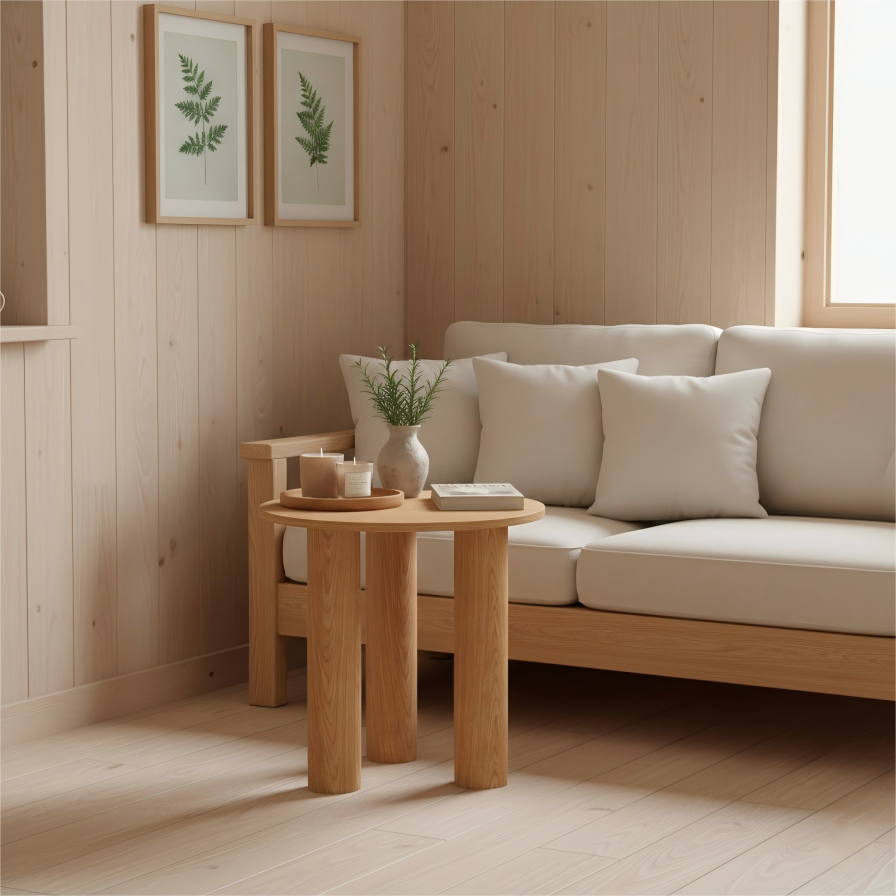
What an accent end table has to do
An end table is a small surface next to seating. The technical overview of an end table describes the basic function and placement.
- Support: hold a lamp, a book, a drink, or a small tray without wobbling.
- Fit: sit level with or slightly below the sofa arm for comfortable reach.
- Look: carry the room's style in a small footprint.
- Durability: survive daily use, cleaning, and moving.
- Logistics: pack, ship, and assemble without excessive damage or labor.
A table that looks good in a photo but wobbles, chips, or takes an hour to assemble will not survive the first review cycle.
Accent end table specs to lock before sampling
These seven specifications should be fixed before the sample is built.
1. Dimensions and height
Define the diameter or width, depth, and height. Check the height against the sofa arm and the lamp base. A table that is too tall feels awkward; one that is too low is hard to use.
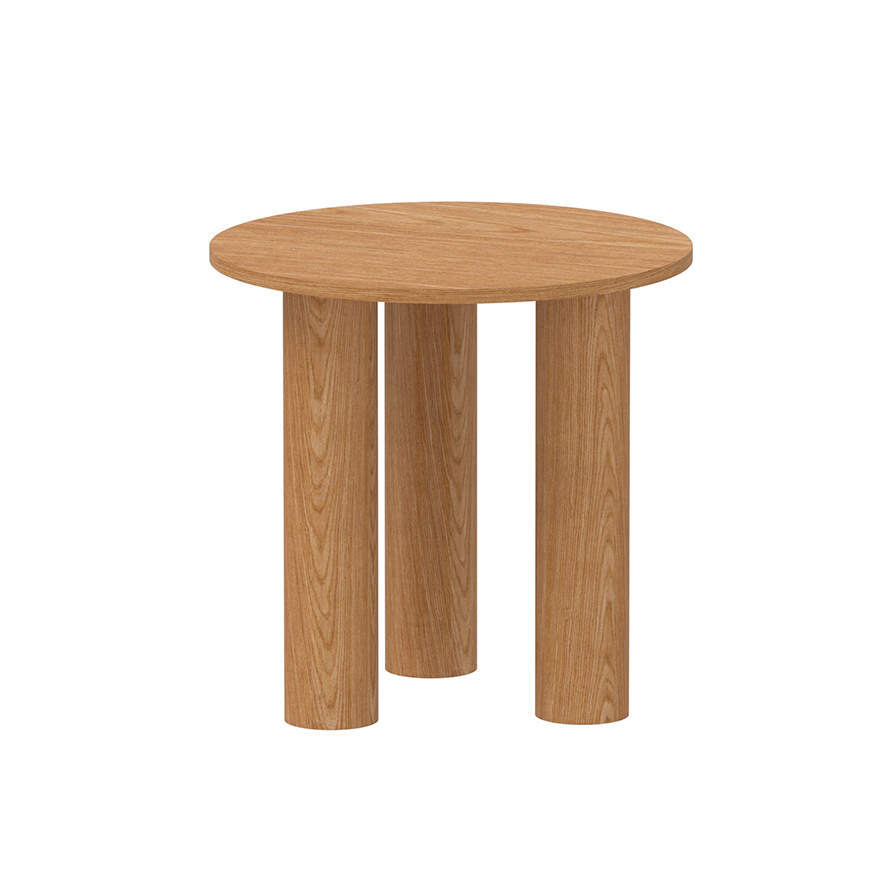
The Rivora example is 500 mm in diameter and 580 mm high, a compact round format for a sofa or bedside position. Confirm the footprint against the room plan, not only the product photo.
2. Material and substrate
Choose the substrate: MDF, particleboard, solid wood, veneer, or a mix. The choice affects cost, finish, weight, screw-holding strength, and moisture resistance.
Ask for the panel grade, density, and formaldehyde compliance for the destination market. A low-cost board can save money at the quote and cost more in returns.
3. Construction and joints
Define how the top, legs, and base connect. A pedestal base, a three-leg base, and a four-leg base behave differently under load and during shipping.
Ask for the joint detail, the hardware, and the assembly method. A table that depends on a single cam lock may loosen after repeated moving.
4. Finish and edge treatment
Specify the finish: veneer, foil, melamine, paint, or powder-coated metal. Define the sheen, color tolerance, and edge banding.
Check the edge profile and the surface touch. A sharp edge or a visible seam makes a low-cost table feel cheaper than it is. Test the finish for water, heat, and household cleaners.
5. Stability and safety
Test the table with a load at the edge, not only in the center. A small table can tip if the top is heavy and the base is narrow.
Confirm the floor protection, the foot material, and the maximum recommended load. If the table is used with a lamp, check the cord path and the heat exposure.
6. Packaging and transit
Define the carton, the corner protection, the inner packing, and the drop test. Essent uses ISTA-3A packaging for e-commerce programs, which is a useful baseline for parcel shipment.
Test a full carton, not only a bare sample. The carton size also affects freight cost and the number of units per container.
7. Assembly and instructions
Define the assembly time, the hardware pack, and the instructions. A five-minute assembly is a selling point; a one-hour assembly is a return risk.
Ask for a photographed instruction sheet and a hardware count. A missing bolt stops the assembly line and creates a customer-service ticket.
MDF vs. particleboard vs. solid wood
The substrate is a cost and performance decision. The table below summarizes the common options.
| Material | Strengths | Watch-outs |
|---|---|---|
| MDF | Smooth surface; easy to shape and paint | Heavy; needs good screw-holding detail |
| Particleboard | Lower cost; stable for flat panels | Edge swelling if water reaches the core |
| Solid wood | Repairable; premium feel | Higher cost; movement with humidity |
Many retail tables combine materials: an MDF top with a solid wood edge, or a particleboard carcass with a veneered surface. The mix can hit a price point, but the specification has to say which part uses which material.
ASTM D1037 covers test methods for wood-base fiber and particle panel materials and is a useful reference for panel properties. Ask for the test data that matches the board you plan to use.
Accent end table recommendations by retail channel
The channel changes the specification more than the style does.
E-commerce and marketplace brands
Parcel shipment rewards small cartons, low damage, and fast assembly. A round table with a compact base can pack efficiently, but the top and legs need corner protection.
Test the carton through the parcel network. A sample that survives a courier handoff may still fail a multi-stop route.
Brick-and-mortar furniture stores
Stores can sell a larger table and a more tactile finish. The display model takes more handling, so the finish and edge durability matter.
Provide a touch-up plan and a clear care label. A floor model with a chipped edge loses the sale.
Hospitality and short-term rental projects
These buyers need a table that survives frequent cleaning and guest use. Commercial-grade laminate or a sealed wood finish may be a better fit than a delicate veneer.
Check the cleaning chemicals and the expected replacement cycle before choosing the finish.
Private-label retail programs
Private label needs a pinned specification, a consistent finish, and a repeatable carton. The same SKU may ship for several seasons.
Ask for a golden sample, a color tolerance, and a packaging artwork proof. A small finish drift becomes a customer complaint at scale.
Interior designers and trade buyers
Trade buyers often want a specific size, finish, or edge detail. The table may be part of a larger room package, so the visual language has to match.
Confirm the lead time and the sample process before the specification is presented to the client.
OEM and ODM brand programs
OEM buyers bring a design; ODM buyers start from a platform and adapt it. Both need a clear specification and a change-control process.
Essent supports ODM/OEM adjustment of top size, thickness, leg diameter, materials, edge profiles, colors, and packaging. Confirm which changes affect tooling and which are configuration changes.
Sampling and validation
A sample is a proposal. Validate it before the production order.
- 3D review: check proportions, leg spacing, and top thickness against the room scene.
- Finish sample: approve the color, sheen, and edge on the actual substrate.
- Load test: test the edge and the center with the intended load.
- Assembly trial: time the assembly with the actual instructions and hardware.
- Carton drop: test the full pack, then inspect the table and the carton.
- Pilot run: produce a small lot and check consistency before mass production.
A sample that passes on a desk may fail in a parcel truck. Test the full pack, not only the product. A quality management system such as ISO 9001 gives the supplier a framework for batch consistency and corrective action.
Where Essent fits
Essent is a custom furniture manufacturer for retail brands. The company reports 2–4 week sampling, 30–60 day production, ISTA-3A packaging, and FSC/BSCI compliance support, with fulfillment from China, the USA, and Germany.
- Side and end tables: ODM and OEM programs for retail and e-commerce.
- Rivora side table: a 500 mm round accent table with a triple-column base.
- Customization: top size, thickness, leg diameter, materials, edge profile, color, and packaging.
Ask about the substrate, finish, carton size, assembly time, MOQ, and sample schedule. Those details decide whether the table fits the price point and the channel. The company's manufacturing background is worth reviewing before you shortlist.
Common mistakes
Most accent table programs fail on details that were never specified.
- Choosing style before the carton. A beautiful table that ships badly becomes a returns problem.
- Ignoring the substrate. The board grade decides weight, screw strength, and moisture behavior.
- No finish tolerance. A color that drifts between batches looks like a different SKU.
- Testing only the center. An edge load is the real stability test for a small table.
- Underestimating assembly. A long assembly time kills the e-commerce review score.
- No golden sample. The second batch becomes a new product.
- No packaging test. A carton that passes once may fail in a different courier network.
A written spec, a golden sample, and a carton drop test prevent most of these problems.
Frequently asked questions
Q1: What is an accent end table?
A1: It is a small table placed at the end of a sofa or beside a chair. It can be round, square, or sculptural, and it usually holds a lamp, a drink, or a small tray.
Q2: What height should an accent end table be?
A2: It should sit level with or slightly below the sofa arm. Measure the arm height and the lamp base before choosing the table height.
Q3: Is MDF or particleboard better?
A3: MDF gives a smoother surface and better shaping; particleboard is usually lower cost and stable for flat panels. The right choice depends on the finish, the edge detail, and the price point.
Q4: How do I test the packaging?
A4: Run a full-carton drop and vibration test that matches the parcel or container route. Then inspect the table, the hardware pack, and the carton for damage.
Q5: Can Essent customize the size and finish?
A5: Ask about top size, thickness, leg diameter, materials, edge profile, color, and packaging. Confirm which changes affect tooling and which are configuration changes.
Request an accent end table sample
A useful inquiry includes more than a request for a price. Tell the team what the table should do and how it will be sold.
- Target channel: e-commerce, retail store, hospitality, trade, or private label.
- Dimensions, shape, and height range.
- Substrate and finish direction.
- Target price, carton size, and assembly time.
- Packaging and drop-test requirement.
- Estimated annual volume, sample date, destination, and compliance needs.
Send those details to Essent and ask for a sample plan and a quotation. The right accent end table is the one that fits the room, the carton, and the price point, not the one that looks best in a single photo.
Sources and further reading
- Wikipedia: End table — a technical overview of end table function and placement.
- ASTM D1037: Standard Test Methods for Evaluating Properties of Wood-Base Fiber and Particle Panel Materials — test methods for MDF and particleboard properties.
- ISO 9001:2026: Quality management systems — Requirements — the current edition of the quality management standard.