International buyers evaluating accent side tables for hospitality,
residential, and contract interiors need more than a visual reference. A
production-ready specification connects dimensions, material performance, finish
consistency, packaging, and order volume before sampling begins. Buyers can
submit target sizes, finish references, and project quantities for review so
that the quotation reflects the actual production route rather than a generic
catalogue item. Essent Hom works with B2B clients on custom side table programs
where drawings, samples, and inspection points are agreed before bulk
production.
The category sits within occasional tables, end tables, and lamp tables, yet
the term usually refers to smaller-scale pieces placed beside seating, beds, or
lounge chairs. In hotel guestrooms, a lamp table may need concealed cable
routing and a durable top surface. In residential projects, an end table may
need to match a broader furniture finish schedule. Contract furniture buyers
often treat these pieces as line items within an FF&E package, which means
the specification must survive procurement review, sample approval, production
inspection, and container loading without losing dimensional or visual
intent.
In contract furniture schedules, accent side tables carry a functional load
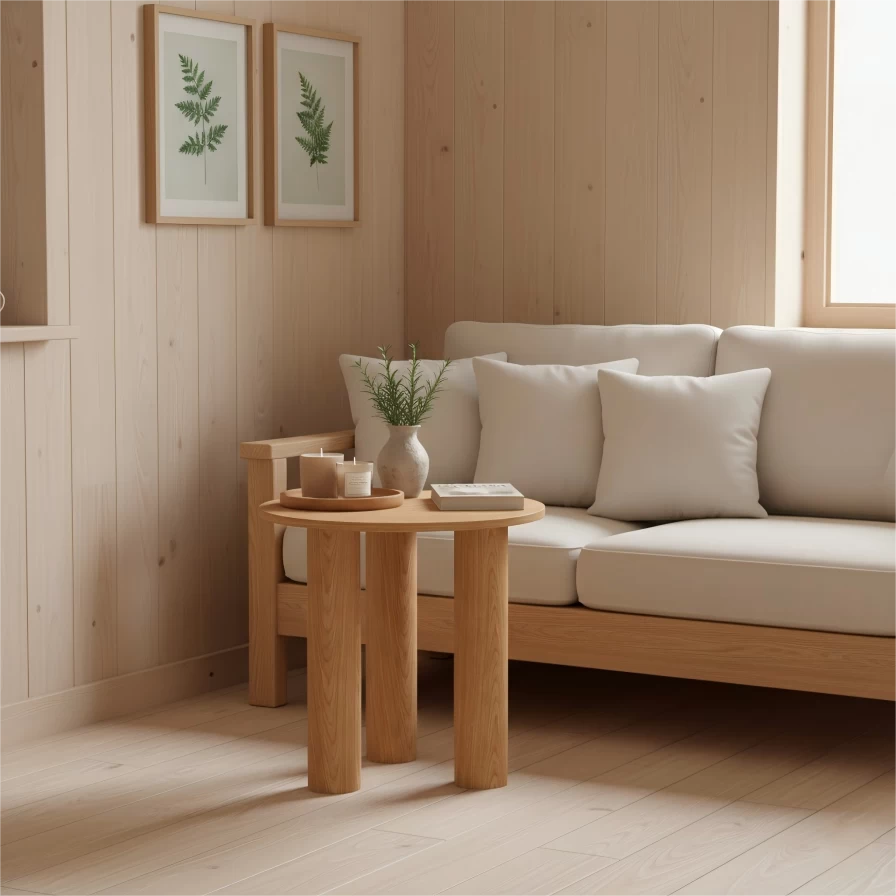
that is disproportionate to their size. They sit at the intersection of guest
comfort, housekeeping durability, and interior design continuity. A loose
specification can create visible mismatches when a guestroom lamp table arrives
with a different sheen from the desk, or when a lounge side table is too tall
for the sofa arm. Procurement teams track these items because they affect room
turnover, replacement planning, and the perceived quality of the finished
interior.
- Guestroom lamp tables require stable tops, edge protection, and concealed
power access where specified.
- Lounge and lobby side tables need surface resistance for beverages, keys,
and frequent cleaning.
- Residential model units rely on proportional consistency across sofas,
armchairs, and bed frames.
- Hospitality FF&E packages often require finish matching across multiple
furniture types and production batches.
Custom Accent Side Tables: Dimensions, Materials, and Structure
A custom program for accent side tables begins with the room plan and the
seating geometry, not with a stock size list. The height relationship between
the table top and the sofa or chair arm determines usability. The base footprint
must fit within circulation zones and housekeeping access. Once those
constraints are fixed, material selection and joinery follow the expected load
and cleaning regime. Essent Hom reviews these inputs with buyers before shop
drawings are issued.
Dimensions and Proportion
Standard side table heights often fall between 500 mm and 650 mm, but
contract projects frequently require adjustments for low sofas, high bed frames,
or modular lounge systems. Top sizes may range from compact 350 mm squares to
600 mm rounds, with rectangular and organic shapes used where the interior
scheme calls for softer geometry. Buyers should confirm whether the stated
dimension includes the top overhang, edge profile, and any removable tray or
inset surface.
- Height relative to sofa arm or mattress top
- Top overhang and edge radius for safety and visual weight
- Clearance for power outlets, cable routing, or drawer pulls
- Base footprint in relation to circulation and cleaning access
Material Selection and Moisture Control
Material selection follows the project environment. Solid wood offers
repairability and visual continuity, while veneered panels provide stable
surfaces across large batches. Metal bases reduce visual mass and can simplify
modular packing. Stone tops add weight and require substrate reinforcement. For
wood components, moisture content should be controlled before machining; a range
of roughly 8% to 12% is common for interior furniture, with the exact target
depending on the destination climate and factory agreement. Panel substrates
should be specified by grade and density rather than by generic names.
Joinery and Load Path
Structural decisions depend on whether the table will carry a lamp, a tray,
or occasional seated weight. Corner blocks, dowels, cam fittings, and metal
brackets each suit different production volumes and disassembly requirements.
Knock-down designs can improve container utilization but require repeatable
fitting accuracy. Fixed bases simplify alignment but increase packed volume. The
load path from top to leg to floor should be reviewed on the shop drawing,
especially for stone tops and slender metal frames.
Finish Matching and Visual Consistency for FF&E Schedules
Finish matching is one of the most common friction points in international
furniture procurement. A approved sample under office lighting can read
differently in a hotel corridor or a residential show unit. Buyers should
provide a physical finish reference, a sheen level, and a substrate description.
Where the side table must match an existing desk or headboard, the factory needs
to know whether the match is by color, grain pattern, gloss level, or all three.
Production batches should be drawn from the same material lot where visual
continuity is important.
- Physical control sample retained by buyer and factory
- Sheen level stated in gloss units rather than descriptive words
- Edge profile and top radius confirmed on the sample
- Batch grouping for veneer and stain consistency
Specifying Side Tables for Hospitality and Residential Projects
Project type changes the priority order. Hospitality buyers tend to focus on
durability, replacement consistency, and housekeeping performance. Residential
buyers tend to focus on proportion, finish harmony, and detail refinement. A
single factory specification can serve both, but the inspection criteria and
packing method should reflect the end use rather than a generic furniture
standard.
Hospitality Guestrooms and Suites
Guestroom lamp tables often include a top surface that resists rings and
cleaning agents, an edge that withstands luggage contact, and a base that
protects wall finishes. Cable routing and outlet access should be coordinated
with the electrical plan. For suites and public areas, larger occasional tables
may need leveling feet and concealed joining details.
Residential and Model Units
Residential projects place greater emphasis on visual proportion and finish
continuity across the living room, bedroom, and study. Custom sizes help align
the table with low-profile seating and bespoke joinery. Buyers should confirm
whether the table will be delivered as a single unit or in knock-down form for
upper-floor access.
Lounge and Workspace Settings
Lounge and workspace side tables may need to support laptops, trays, or
shared seating arrangements. The top surface should suit the cleaning regime,
and the base should remain stable on carpet tiles or hard floors. Where tables
are grouped, repeatable dimensions matter more than individual variation.
Procurement Pain Points and Practical Solutions
B2B buyers face predictable friction when sourcing occasional tables across
borders. The issues usually appear at the interfaces between design intent,
factory capability, and logistics. A practical solution is to convert each
design decision into a measurable production parameter before the purchase order
is issued.
- Inconsistent finish across batches: retain a physical control sample and
group veneer lots.
- Dimensional drift after sampling: approve a dimensioned shop drawing with
tolerance notes.
- Unclear MOQ: separate trial order quantities from mass production quantities
in the quotation.
- Packing damage: specify corner protection, top surface protection, and
carton drop orientation.
- Container inefficiency: review knock-down options against assembly time and
fitting accuracy.

Quality Control, Sampling, and Packaging
Quality control should be tied to the approved sample and the shop drawing.
Inspection points are more useful when they are scheduled at material receipt,
after machining, after finishing, and before packing. This sequence catches
moisture, dimension, and finish issues while correction is still practical.
Essent Hom reviews these checkpoints with buyers so that the inspection plan
matches the order structure.
Pre-Production Samples
A pre-production sample confirms proportions, finish, edge detail, and
hardware before bulk materials are cut. The sample should be made with the same
substrate and finish system as the production order. Buyers should record the
approval date and retain a sealed reference.
Inspection Points
Inspection should cover top flatness, leg length consistency, joint
tightness, sheen level, edge smoothness, and hardware function where applicable.
For stone tops, thickness and edge polish should be checked against the drawing.
For metal bases, weld appearance, coating adhesion, and floor contact should be
reviewed.
Packaging and Container Loading
Packaging protects both the finish and the geometry. Tops should be separated
from hard components, and corners should be reinforced. Carton markings should
identify orientation and item codes. Container loading plans should account for
the ratio of tops to bases and any knock-down fittings. Mixed orders benefit
from a loading sequence that matches the installation schedule.
Frequently Asked Questions
What is the typical lead time for custom accent side tables?
Lead time depends on sample approval, material availability, finish
complexity, and order quantity. A trial order usually requires drawing review,
sample production, and buyer approval before bulk production. Mass production
scheduling should be confirmed after the sealed sample and purchase order are in
place.
Can side tables be produced to match existing FF&E finishes?
Finish matching is possible when the buyer provides a physical reference,
substrate information, and sheen target. Where an exact match is not practical
across different materials, the factory can propose a close match and provide a
sample for approval before production.
What MOQ applies to B2B side table orders?
MOQ varies by material, finish, and construction method. Trial orders are
often discussed separately from mass production quantities. A mixed order across
several table sizes may improve material utilization, but the quotation should
state the minimum quantity per finish and per model.
Which materials are suitable for hospitality side tables?
Solid wood, veneered panels, metal, stone, and glass are all used in
hospitality furniture. The selection should reflect cleaning agents, surface
wear, weight limits, and replacement planning. Stone and glass require substrate
and edge treatment review, while wood and veneer require moisture control and
finish durability.
How are occasional tables packed for container shipping?
Packing usually combines inner protection, corner reinforcement, and outer
cartons. Tops and bases may be packed separately in knock-down programs. The
loading plan should consider stack height, humidity exposure, and unloading
sequence at the destination.
Can dimensions be adjusted for tight floor plans?
Dimensions can be adjusted within the structural limits of the chosen
material and joinery. Buyers should provide the seating height, available floor
area, and clearance requirements. The factory then confirms the revised drawing
and checks whether the base still provides stable support.
What quality checks apply to joinery and finish?
Joinery checks include joint tightness, squareness, leg alignment, and
hardware function. Finish checks include color against the sealed sample, sheen
level, surface smoothness, and edge coverage. Inspection records should
reference the approved drawing and sample date.
Submitting Project Specifications for Review
When submitting an inquiry for accent side tables, include the target
dimensions, material direction, finish reference, estimated quantity,
destination port, and any installation constraints. Drawings, inspiration
images, and sample requirements help the factory quote a realistic production
route. Inquiries can be sent to Essent Hom with these details so that the review
covers construction, sampling, packing, and container planning before commercial
terms are finalized.