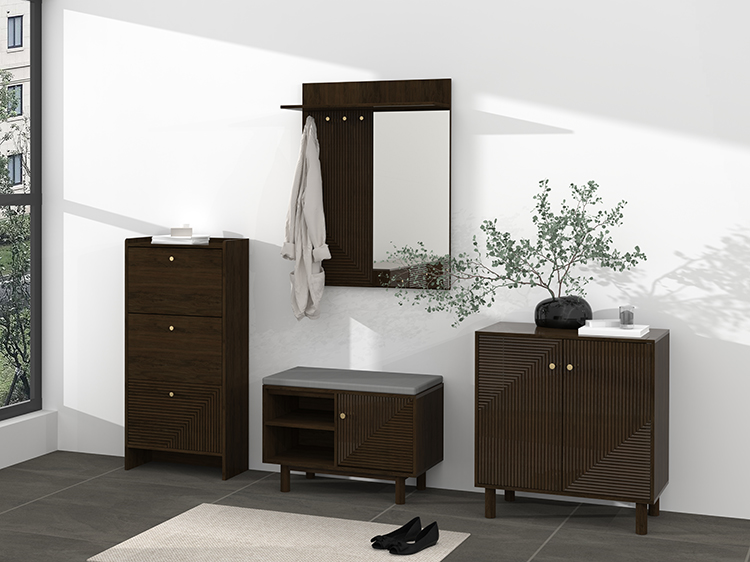
Partnering with the right kitchen table factory determines product quality, delivery reliability, and profit margins. Unlike small workshops, a professional factory offers scalable production, consistent finishes, and compliance with international safety standards. Essent Home has operated its own manufacturing facilities for over 15 years, supplying dining tables to retailers in North America, Europe, and Asia. This guide outlines nine technical and operational factors to assess before selecting a factory partner.
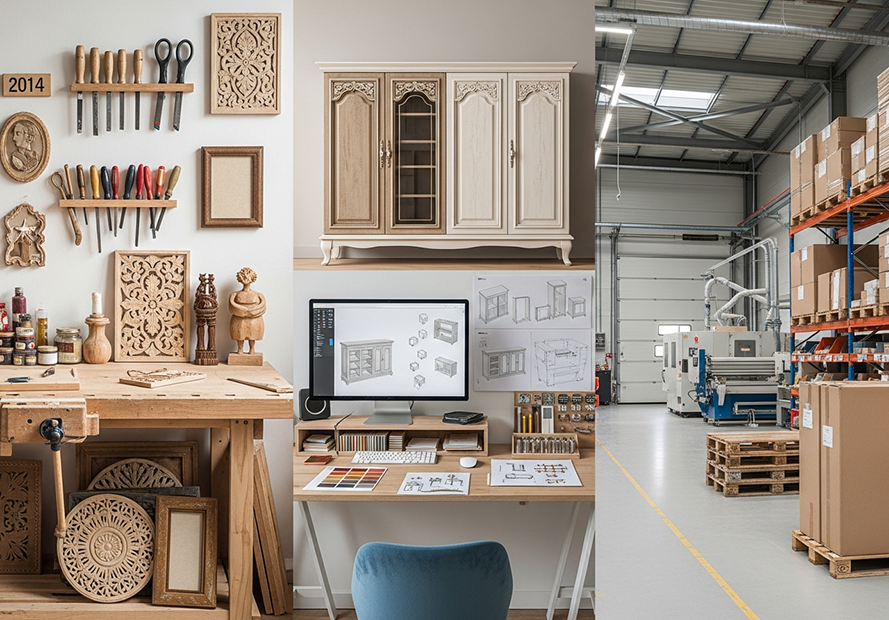
1. Wood Processing and Moisture Control
The first step in evaluating a kitchen table factory is their wood conditioning process. Properly dried lumber prevents warping, cracking, and joint failure after delivery.
Kiln drying capacity: Does the factory operate its own kilns or outsource? In-house kilns allow better control. Target final moisture content (MC) of 6–8% for solid wood tables.
Moisture meter checks: Every board should be tested before cutting. Acceptable variation ±1% MC within the same batch.
Acclimatization period: After kiln drying, lumber should rest in factory conditions for at least 72 hours before processing.
Essent Home uses four vacuum kilns that reduce drying time from 30 days to 8 days while preserving wood color. We provide MC readings for each production lot.
2. Joinery Techniques and Structural Integrity
A high-quality kitchen table factory employs proper joinery, not just screws and glue. Key methods to look for:
Mortise and tenon: For leg-to-apron connections. Provides superior shear strength compared to pocket screws.
Dovetail or box joints: For drawers (if table includes storage).
Corner blocks and brackets: Additional reinforcement for high-traffic commercial tables.
Biscuit or domino joinery: For edge-gluing tabletop planks. Prevents separation over time.
Essent Home’s joinery shop uses CNC tenon cutters with ±0.1mm tolerance. Each assembled frame undergoes a 200 lb weight test before finishing.
3. Finishing Line and Coating Technology
The finish protects the table from spills, heat, and abrasion. Inspect the kitchen table factory’s finishing department for:
Spray booths: Downdraft or crossdraft with water curtains to capture overspray. Clean booths indicate quality focus.
Coating types: Water-based lacquers (low VOC), conversion varnish (durable for commercial), or hard wax oils (natural look).
Number of coats: Minimum 2 sealer coats + 2 topcoats for lacquer. Sanding between coats with 320–400 grit.
UV curing line: For high-volume factories, UV-cured finishes are instant-dry and extremely hard.
Essent Home operates an automated UV finishing line that applies five coats in 90 seconds. We test each batch for cross-hatch adhesion (ASTM D3359) and chemical resistance (ethanol, coffee, vinegar).
4. Quality Control and Defect Tolerances
Consistency across thousands of units separates a professional kitchen table factory from a job shop. Request these QC documents:
Incoming raw material log: Rejection rate for warped or damaged lumber (target <3%).
In-process inspection (IPI): Checks at cutting, sanding, assembly, and packing. Reject rates per station.
Final random inspection (FRI): Based on ANSI/ASQ Z1.4, AQL 1.5 for major defects (e.g., loose leg, finish peeling).
Color consistency records: Spectrophotometer readings (ΔE ≤ 1.5 between batches).
Essent Home provides a digital QC report for every order, including photos of 20 randomly selected units. Our annual defect rate (customer-reported) is 0.8%.
5. Production Capacity and Lead Time Reliability
A kitchen table factory must match your volume needs. Key metrics to ask:
Monthly output: Number of tables per shift. Small factories: 500–1,000 units. Medium: 2,000–5,000. Large: 10,000+.
Lead time for first order: Typically 45–75 days including sample approval. Repeat orders: 30–45 days.
Peak season buffer: Can they increase capacity by 30% during Q3 (August–October) without delays?
Order tracking system: Does the factory provide weekly production updates with photos?
Essent Home’s factory produces 3,500 dining tables per month across three assembly lines. We maintain a 30-day raw material safety stock to avoid weather or logistics disruptions.
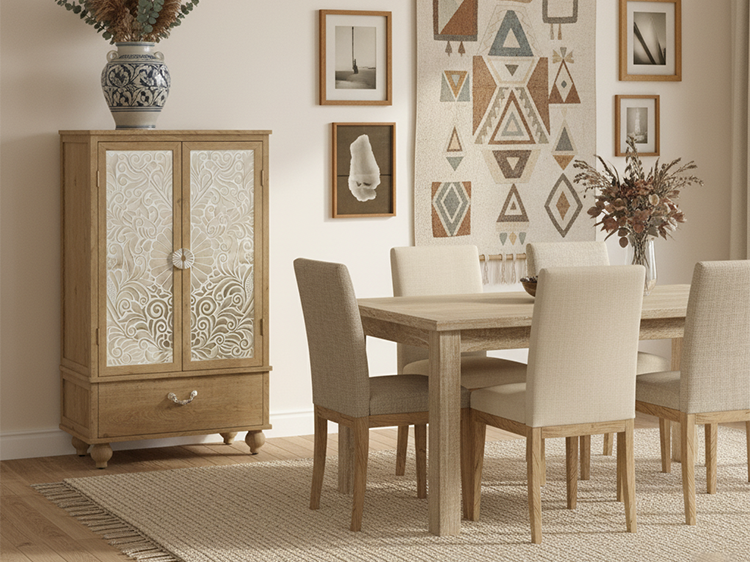
6. Material Sourcing and Chain of Custody
End consumers increasingly demand certified sustainable wood. Verify that the kitchen table factory can provide:
FSC or PEFC certification: For solid wood and veneers. Request the license code and verify online.
Lacey Act compliance: For imports into the US – declaration of species and harvest country.
Low-formaldehyde panels: If using plywood or MDF, specify CARB Phase 2 or EPA TSCA Title VI.
Metal components: Powder-coated steel with RoHS compliance for finishes.
Essent Home is FSC-certified (license SGSHK-COC-010345) and sources all oak, walnut, and ash from managed forests in Pennsylvania and Germany.
7. Packaging Engineering and Damage Prevention
Fragile tabletops require engineered packaging. A responsible kitchen table factory will provide:
Knock-down (KD) design: Legs removable to reduce shipping volume. Flat-packed tables reduce damage risk.
Edge protectors: Cardboard or foam (recycled polyethylene) covering all corners.
Corrugated carton: Double-wall (200 lb test) with die-cut inserts to immobilize parts.
Drop test report: ISTA 1A or 3A simulation. Minimum 24” drop on edges and corners without structural failure.
Essent Home’s packaging lab performs weekly drop tests. Our standard carton design achieves a 99.2% damage-free rate in parcel carrier networks (FedEx, UPS).
8. Compliance with Safety and Food Contact Standards
Kitchen tables may contact food directly. Ensure the kitchen table factory can supply test reports for:
FDA 21 CFR 175.300 (US): Migration limits for resinous and polymeric coatings.
LFGB (Germany): More stringent migration tests for food simulants (3% acetic acid, 50% ethanol).
Lead and heavy metals: Surface coating must contain ≤90 ppm lead (US CPSIA).
Formaldehyde emissions: ≤0.05 ppm for composite wood (CARB Phase 2).
Essent Home submits finish samples to SGS annually. We provide an LFGB certificate for all dining table models intended for food preparation.
9. After-Sales Support and Warranty
A reliable kitchen table factory stands behind its products. Ask about:
Warranty period: Minimum 1 year structural (frame, legs). Some offer 3–5 years on finishes.
Replacement parts policy: Availability of touch-up markers, spare leg levelers, and corner brackets for 5 years.
Defect claim process: Photos required, response within 48 hours, replacement or refund for confirmed defects.
Factory training for your customer service team: Some factories provide assembly videos and troubleshooting guides.
Essent Home offers a 2-year warranty covering material and workmanship. We keep a 5% spare parts inventory for every order shipped.
Common Industry Pain Points and Solutions
Pain point: Inconsistent wood color between batches. Solution: Use a spectrophotometer-based color management system. Essent Home’s finishing line adjusts stain flow automatically based on real-time color readings.
Pain point: Legs wobble after assembly. Solution: Pre-install threaded inserts in aprons with precise alignment jigs. Essent Home uses CNC-drilled pilot holes with ±0.5mm accuracy.
Pain point: Finish scratches during transit. Solution: Apply protective film (peelable) on tabletops before packaging. Essent Home uses 3M™ protective tape rated for 90 days.
Why Essent Home Is a Preferred Kitchen Table Factory
Essent Home operates a 120,000 sq ft kitchen table factory with 280 skilled workers. Our advantages include:
CNC machining centers (Biesse, SCM) for precision cutting and tenoning.
In-house finishing lab with 20 standard colors and custom matching.
Digital sample approval via 3D scanning – reduces physical prototype cycles by 40%.
BSCI social compliance audit (score: 85/100).
Essent Home supplies dining tables to Costco, Home Depot, and regional furniture chains. We welcome factory tours and live video inspections.
Frequently Asked Questions (FAQ)
Q1: What is the typical MOQ when working directly with a kitchen
table factory?
A1: For stock designs (existing models), MOQ ranges
from 100–300 pieces per SKU. For custom designs (your dimensions, wood, finish),
MOQ is usually 200–500 pieces. Essent Home offers a “low MOQ program” with 80
pieces for first-time partners.
Q2: How long does it take to receive a sample from a kitchen table
factory?
A2: For an existing design, sample lead time is 10–15 days.
For a fully custom design (new size, shape, finish), expect 25–35 days. Essent
Home provides 3D renders within 5 days for approval before physical
sampling.
Q3: Can a kitchen table factory apply my brand logo to the
tables?
A3: Yes. Common methods: hot stamp into wood, engraved metal
plate, or printed under the clear coat. Essent Home offers laser engraving
(readable or decorative) at no additional cost for orders above 200 pieces.
Q4: How do I verify a factory's finish durability before bulk
production?
A4: Request a finish test panel (12"x12") and perform
your own tests: coffee/hot mug (80°C for 1 hour), red wine (24 hours), and
scratch test with a coin. Essent Home provides certified test reports from
independent labs (SGS, TÜV).
Q5: What is the difference between a kitchen table factory and a
trading company?
A5: A factory owns production equipment, employs
workers, and controls quality directly. A trading company outsources to multiple
factories, adding markup and reducing control. Essent Home is a true factory –
you can video-call us from the production floor at any time.
Request a Factory Capability Report and Quotation
Selecting the right kitchen table factory ensures consistent quality and on-time delivery. Essent Home offers a free factory audit package: a 20-page PDF detailing our equipment list, QC flow, material certifications, and client references. We also provide sample pricing for five popular dining table designs (FOB or DDP).
Contact Essent Home’s sales engineering
team:
Website: https://essentfurniture.com/
Email:
+86 0591-22068125
Phone:ceciliahuang@essenthome.com
Send your target price point, annual volume estimate, and any specific wood/finish preferences. Essent Home will respond with a tailored factory capability presentation and a sample order timeline within 2 business days.