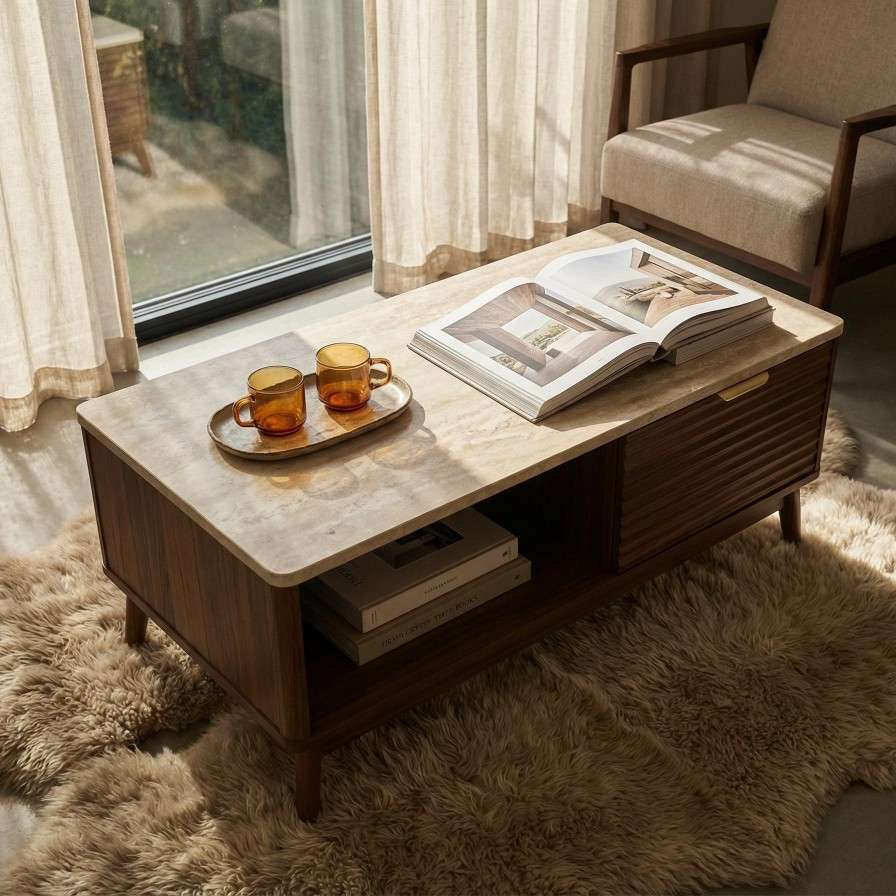
Look at the most celebrated luxury living spaces designed over the past
twelve months. A distinct pattern emerges. The uniform, catalog-driven living
room is officially obsolete.
For years, high-end residential design relied heavily on factory-fresh
minimalism. Rooms featured flawless neutral palettes, pristine engineered
surfaces, and matching showroom sets. While clean, these spaces often felt cold,
sterile, and devoid of soul.
In 2026, the luxury residential market demands narrative depth. Discerning
clients no longer ask for spaces that look brand new. Instead, they seek homes
that feel thoughtfully assembled across decades.
At the center of this movement sit vintage coffee tables. Once treated as an
afterthought in spatial layouts, the low table has claimed the spotlight as the
ultimate visual anchor of the curated interior.
The Generational Shift: From Mass Production to Curated Luxury
The interior design world has moved past the initial phase of "quiet luxury."
In 2026, the prevailing philosophy is curated luxury. Homes function as private
galleries that reflect personal history, tactile curiosity, and individual
taste.
Standardized, mass-manufactured pieces cannot satisfy this appetite.
Discerning homeowners recognize that factory-made tables lose both financial and
aesthetic value the moment they leave the crate. They show wear through
deterioration rather than graceful aging.
A vintage low table changes the energy of a room immediately. It introduces
historical friction into clean architectural plans. It softens sharp drywall
angles and balanced lighting layouts with human handwork and honest age.
Design authorities like Architectural Digest continually
highlight this dialogue between historical artifacts and contemporary volumes. A
single weathered surface instantly proves that a home was collected, not merely
decorated.
The Core Value: Why Vintage Coffee Tables Dominate the High-End Market
The rapid rise of vintage coffee tables among elite specifiers is not a
passing decorative whim. It rests on solid functional, economic, and aesthetic
realities.
The Irreplaceable Value of Patina
Patina cannot be manufactured in a factory. It requires thirty, fifty, or one
hundred years of ambient light, shifting humidity, hand contact, and seasonal
contraction. It creates an organic map of time across a material's surface.
Whether it appears as oxidized brass, hand-rubbed French walnut, or mellowed
Roman travertine, authentic age possesses tactile warmth. Modern artificial
aging techniques attempt to replicate this look, but discerning collectors spot
the difference instantly.
Original age marks ground a room. They make a multi-million-dollar space feel
inviting and lived-in rather than stiff and fragile.
Sustainable Luxury Furniture as a Status Marker
In 2026, sustainability is no longer a corporate buzzword. It serves as a
decisive baseline for ultra-high-net-worth design specifications. True luxury
avoids continuous extraction.
Specifying sustainable luxury furniture through vintage pieces keeps historic
craftsmanship in circulation. It honors dense, old-growth timber, rare stone
slabs, and cast bronzes that cannot be ethically sourced today.
Acquiring an authentic mid-century or antique piece shows environmental
sophistication. It demonstrates that the homeowner values preservation over
disposable consumption.
Investment Value and Provenance
High-end furniture should act as a store of value, much like fine art. When
you purchase high-grade vintage design, your capital does not evaporate into
retail markup.
Historic pieces by documented masters routinely hold their value or
appreciate on secondary auction markets like 1stDibs. A rare brutalist coffee
table or signed post-modern console is an asset class you can use every day.
Institutional collectors understand this reality well. They view a
master-built coffee table not as an expense, but as an heirloom that anchors
their real estate portfolio.
Four Vintage Coffee Table Archetypes Shaping 2026 Interiors
Different architectural contexts require specific historical weights and
silhouettes. Four core vintage movements currently command attention in 2026
interior design trends.
1. Mid-Century Modern (MCM) Organic Forms
The mid-century modern vintage coffee table remains a perennial favorite, but
specifier preferences have sharpened. Designers have moved away from ubiquitous
molded plywood toward richer, sculptured timber expressions.
- Dominant Materials: Brazilian rosewood, aged solid teak,
rich walnut, hand-cast bronze hardware.
- Notable Influences: Isamu Noguchi, Charlotte Perriand, Finn
Juhl, George Nakashima.
- Ideal Setting: Sharp, double-height modern living rooms
that need organic warmth and curvilinear balance.
Perriand-inspired freeform slabs and Nakashima-style butterfly joints soften
rigid modular sectionals. They bring natural geometry and warmth to open floor
plans.
2. 1970s Brutalism and Post-Modern Monoliths
As minimalist interiors grow larger, lightweight coffee tables often look
lost. Designers are turning to the raw, sculptural heft of the 1970s to solve
this scale issue.
- Dominant Materials: Italian unfilled travertine,
tessellated marble, acid-etched brass, torch-cut steel.
- Notable Influences: Paul Evans, Willy Rizzo, Karl Springer,
Afra & Tobia Scarpa.
- Ideal Setting: Expansive penthouses and gallery-style
concrete residences.
A rare brutalist coffee table serves as functional sculpture. The rough,
geologic textures contrast beautifully with smooth bouclé, linen, and polished
plaster walls.
3. Rustic Antiques and Wabi-Sabi Low Tables
The wabi-sabi philosophy continues to influence the ultra-prime residential
market. The focus rests on modesty, organic texture, and the beauty of natural
aging.
- Dominant Materials: Reclaimed 19th-century elm, weathered
French oak, hand-hewn river stone.
- Notable Influences: Primitive merchant benches, Asian kang
tables, rustic European farm equipment tables.
- Ideal Setting: Sun-drenched coastal villas, alpine
retreats, and understated limestone townhouses.
These antique coffee tables for luxury living room schemes bring an earthy
weight that grounds high-ceilinged spaces. Their rough-hewn tops invite daily
touch without fear of accidental damage.
4. Space Age and High-Gloss Glass Revivals
Retro-futurism from the late 1960s and early 1980s is returning to urban
penthouse projects. This aesthetic favors sleek reflections over rustic
finishes.
- Dominant Materials: Thick smoked float glass, tubular
chrome, mirror-polished aluminum, high-gloss lacquer.
- Notable Influences: Michel Ducaroy, Joe Colombo, Fontana
Arte artisans.
- Ideal Setting: Moody, layered urban spaces, media salons,
and historic lofts.
Glass-topped vintage coffee tables keep floor areas visually open. They allow
intricate hand-knotted silk and wool rugs underneath to remain completely
visible.
The Art of Curation: Integrating Vintage Pieces into Modern Schemes
Placing an aged table into a modern residential scheme requires precise
visual balance. A successful arrangement avoids looking like an antique showroom
by balancing past eras with present-day forms.
At Essent Home, we guide trade
clients to embrace sharp contrasts. Pair a heavily pitted, hand-carved stone low
table with a tailored, modern Italian modular sofa. The clean lines of modern
upholstery highlight the rough character of the antique stone.
Scale is essential. In expansive, open-concept living rooms, standard retail
dimensions often look small and insubstantial. Consider using two smaller
brutalist blocks side by side, or select an extended, low-slung primitive bench
that spans the full length of your seating layout.
Keep your tabletop styling intentional and restrained:
- Avoid Overcrowding: Let the wood grain, stone veining, or
metal patina remain the primary visual statement.
- Use Asymmetry: Offset an art monograph with a single,
unglazed ceramic vessel or an oxidized bronze bowl.
- Vary Textures: Pair smooth stone table surfaces with
textured paper books, rough ceramics, and matte brass objects.
The Specifier’s Blueprint: Authenticating Vintage Coffee Tables
Because the market values authentic vintage design so highly, specifiers must
know how to spot period-correct pieces and avoid modern reproductions.
Start your inspection with the joinery. Authentic mid-century and antique
wood tables feature hand-cut mortise-and-tenon or dovetail joints. Modern
machine cut joinery is too uniform. Run your fingers beneath the frame:
secondary structural timbers should show hand-planing marks or natural aging,
not fresh synthetic coatings.
Check for genuine maker marks, burnt brands, stamps, or paper labels beneath
the main top. Documented pieces from European workshops often carry inventory
stamps or foundry marks that verify their provenance.
Distinguish between historic patina and actual structural damage:
- Acceptable Age Signs: Surface crazing in historic lacquer,
light sun-fading on timber tops, gentle oxidation on brass, and softened corner
edges.
- Problematic Damage: Active wood rot, deep structural
fissures cutting through stress joints, warped support rails, and poorly
executed modern recoatings.
Major international auction institutions such as Sotheby's emphasize that original surface condition drives
value. Avoid over-restoring a piece. Stripping an original finish to erase minor
stains destroys the history and financial worth of an antique table.
Frequently Asked Questions
Q1: How do I tell if a vintage coffee table is authentic or a
reproduction?
A1: Inspect the joinery, materials, and hardware. Authentic
period tables show subtle irregularities from handcrafting, period-appropriate
hardware, and genuine wear on contact points like base rails and feet.
Reproductions often use modern fasteners, metric screws, artificial stains, and
synthetic particle cores beneath thin veneer skins.
Q2: Can vintage coffee tables withstand daily use in family
homes?
A2: Yes. Historic tables constructed from solid hardwood,
cast metal, or natural stone are often more durable than modern mass-market
alternatives. Most pieces have already endured decades of use. Regular waxing
for wood, proper sealers for stone, and coaster use for delicate lacquers will
easily keep them functional for daily family life.
Q3: What standard height should I look for in a luxury living room
table?
A3: Modern living room layouts favor low proportions. A
coffee table should sit level with, or one to two inches below, your sofa's seat
cushion height. For low-slung contemporary seating, search for vintage models
between 12 and 16 inches (30 to 40 cm) tall to maintain clean sightlines across
the room.
Q4: How do I protect and clean vintage surfaces without harming their
patina?
A4: Avoid modern chemical sprays and silicone-based
furniture polishes. Clean solid wood by dusting with a dry microfiber cloth and
applying an unbleached paste wax once or twice a year. Wipe stone and metal
surfaces with distilled water and mild pH-neutral soap, then dry them
immediately to protect their natural, oxidized finish.
Q5: Why are travertine and marble vintage coffee tables so popular
for 2026?
A5: Stone tables provide a solid, grounding presence in
open-plan living rooms. Natural materials feature unique, unrepeatable veining
patterns that age gracefully. Travertine and marble also bridge the visual gap
between warm, organic accents and clean architectural finishes.
Partner with Essent Home on Your Next Project
A home should tell a layered, compelling story. Mass-produced furniture
cannot provide the depth, material honesty, and individuality that modern
high-end clients expect.
Choosing authentic vintage coffee tables honors historical craftsmanship and
supports sustainable luxury furniture design. Most importantly, it creates rooms
that feel confident, composed, and truly unique.
Connect with Essent Home: Are you seeking specific period
designs, bespoke stone works, or vintage statement tables for a commercial or
residential development? Contact our curation and manufacturing trade desk
today. Share your architectural drawings, material palettes, and target
timelines to receive our trade catalog and custom sourcing support.