For hotel procurement managers, residential developers, and furniture
distributors, selecting a reliable media console
exporter is more than a transactional decision—it directly impacts
project timelines, brand reputation, and end-user safety. Media consoles (also
known as TV stands or entertainment centers) must meet diverse international
standards for material safety, structural integrity, and fire resistance. This
article provides a technical deep dive into what distinguishes a professional
media console exporter, covering wood engineering, finish
durability, packaging engineering, and logistics risk management. Drawing on the
expertise of Essent Home, a premium OEM/ODM
furniture manufacturer, we outline the critical factors that B2B buyers must
evaluate.
Unlike domestic furniture suppliers, an international media
console exporter must navigate varying import regulations,
container optimization, and climate-adaptive packaging. The following
capabilities separate a competent exporter from an unreliable one:
Certification management: CARB Phase 2 (for composite
wood), TSCA Title VI, EUTR (European Union Timber Regulation), and FSC chain of
custody.
Anti-tipping hardware compliance: ASTM F3096 (US) or EN
16122 (EU) for furniture stability.
Finish testing: Resistance to heat, humidity, and abrasion
per ASTM D1308 or ISO 4211.
Container loading engineering: Flat-pack versus assembled
configurations, with calculated weight distribution to avoid transit
damage.
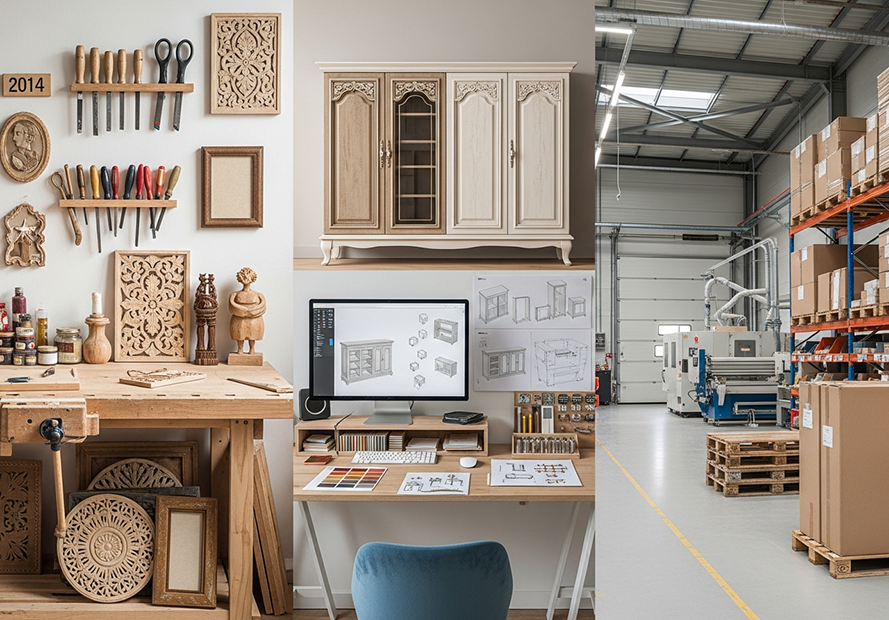
Leading manufacturers like Essent Home operate as an
integrated media console exporter, providing in-house testing
labs and pre-shipment inspections that meet the requirements of major retailers
(e.g., Wayfair, Home Depot, Amazon). Their extensive product portfolio includes modular, rustic, and mid-century modern media consoles engineered for
global shipping.
2. Material Selection and Engineering for Export-Ready Media Consoles
2.1 Substrate Specifications
A media console
exporter must offer clarity on core materials. High-density
fiberboard (HDF, >800 kg/m³) provides better screw-holding strength than
standard MDF for mounting heavy televisions (up to 70 kg). For high-humidity
destinations (Southeast Asia, coastal regions), moisture-resistant MDF (MR-MDF)
with wax emulsion is mandatory to prevent edge swelling. Plywood (poplar or
birch core) is preferred for high-end consoles because it resists warping over
large spans (e.g., 2000 mm length).
2.2 Veneer and Foil Finishes
Real wood veneer (0.5–0.6 mm thickness) requires careful matching of grain
direction across doors and drawer fronts. For cost-effective export, PVC foil
(0.4–0.5 mm) with a matt or textured finish is widely accepted. However, a
premium media console exporter will offer polyurethane (PU)
lacquer over veneer, achieving a 3H hardness rating and resistance to common
household chemicals (e.g., ethanol, coffee). Always request a cross-cut test
(ASTM D3359) to ensure adhesion—minimum rating 4B.
3. Structural Design for Safe Global Distribution
International shipping exposes furniture to vibration, stacking compression,
and temperature swings (-20°C to 60°C). An experienced media
console exporter designs products with the following engineering
features:
Knock-down (KD) fittings: Cam locks with metal dowels (not
plastic) for repeated assembly. Minimum 5 cycles without loosening.
Corner blocking: 20x20 mm solid wood blocks glued and
stapled at all internal corners to resist racking forces during container
transit.
Back panel design: 4–5 mm thick hardboard nailed into a
groove, not just stapled on the rear, to provide shear strength.
Drawer slides: Full-extension, soft-close slides rated for
30 kg load (tested per ANSI/BIFMA X5.1).
These specifications are standard for Essent Home, which offers customizable engineering
drawings for each media console model. The company acts as a media
console exporter that shares 3D assembly instructions and tooling files
prior to mass production.
4. Packaging Engineering for Damage Reduction
Inadequate packaging is the leading cause of claims against a media
console exporter. Professional exporters follow ISTA 3A or 6A
testing protocols. The following elements are non-negotiable:
Edge protectors: L-shaped cardboard or plastic profiles on
all corners.
Polyethylene foam (EPE): 30 kg/m³ density, wrapping each
component with at least 10 mm thickness.
Desiccant bags: Silica gel (50–100 g per carton) to absorb
moisture during ocean transit.
Double-wall cartons: 200 lb burst strength, with hand holes
for lifting.
Beyond individual cartons, container loading patterns must be simulated. A
reliable media console exporter will provide a loading plan
indicating weight distribution (heavy cartons at the bottom, light on top) and
bracing with dunnage bags to prevent shifting. For example, a 40HQ container can
hold 250–300 flat-packed media consoles if optimized.
5. Compliance and Documentation for Smooth Customs Clearance
When importing media consoles, buyers face strict regulations on wood
treatment, formaldehyde emissions, and flame retardants. A competent media
console exporter supplies the following documents with every
shipment:
Phytosanitary certificate (for solid wood components)
confirming heat treatment (ISPM 15).
Formaldehyde emission test report from a recognized lab
(e.g., SGS, TÜV) showing compliance with California 93120 or EU E1 limits
(≤0.124 mg/m³).
Bill of lading (BOL) with correct HS code (9403.60 for
wooden furniture).
Packing list specifying carton dimensions, gross/net
weight, and piece count.
Failure to provide these documents results in detention charges (typically
$200–$500 per day) or even destruction of goods. Essent
Home as a media console exporter includes a
compliance checklist with each proforma invoice, significantly reducing buyer
risk.
6. Industry Pain Points and Solutions for B2B Media Console Sourcing
6.1 Inconsistent Finish Color Between Batches
Problem: A buyer receives two containers of the same model
but with noticeable color difference (delta E >2). Solution: Require the media console exporter to provide a master color
panel and spectrophotometer readings (CIELAB values) for each batch. A
professional exporter will also conduct a 100% visual inspection under D65
light.
6.2 Missing Hardware or Assembly Instructions
Problem: Arrival of containers lacking cam locks, screws, or
hex keys, rendering product unsellable. Solution: Specify that
hardware bags must be sealed and weighed during packing, with a photo record.
The exporter should include a QR code on the carton linking to a PDF of the
assembly guide.
6.3 Transit Damage to Glass Shelves or Doors
Problem: Tempered glass panels shattered despite foam
wrapping. Solution: Use 5 mm tempered glass with beveled edges
and pack each glass piece in a separate styrofoam channel, placed in the center
of the carton away from corners. Alternatively, replace glass with acrylic
(PMMA) for markets with rough handling.

7. Logistics Optimization: Reducing Cost and Carbon Footprint
A strategic media console
exporter assists buyers in choosing between FCL (full container
load) and LCL (less than container load) based on order volume. For a typical
40-foot container, the maximum payload is 26,000 kg, but volumetric efficiency
matters more for furniture. Flat-packed media consoles achieve a stowage factor
of 2.5–3.0 m³ per metric ton. To reduce ocean freight costs by 12–15%, consider
the following:
Design consoles with removable legs and back panels to reduce carton
height.
Use nested packaging for multiple units per carton (e.g., two TV stands in
one box).
Consolidate shipments with other wooden furniture items from the same
exporter.
Essent Home offers a logistics
planning service as part of its media console exporter package,
including warehouse consolidation at the port of loading (Ningbo or Shenzhen)
and real-time container tracking.
Frequently Asked Questions (FAQ) – Media Console Exporter
Q1: What certifications should I request from a media console
exporter before placing a bulk order?
A1: For the US market, request
CARB ATCM 93120-2019 (Phase 2) for composite wood, TSCA Title VI compliance, and
ASTM F3096 anti-tip test report. For Europe, demand EN 16122 stability test, E1
formaldehyde class, and REACH SVHC declaration. A professional media
console exporter like Essent Home provides these
certificates pre-shipment.
Q2: What is the typical lead time for a custom media console order
(OEM) from an exporter?
A2: For a new design (custom dimensions,
finish, and packaging), the lead time is 45–60 days: 15 days for engineering and
prototyping, 30 days for mass production, and 7 days for pre-shipment inspection
and container loading. Repeat orders (existing SKUs) can be 25–35 days. Always
include a buffer of 2–3 weeks for ocean transit.
Q3: How do I verify the financial reliability of an overseas media
console exporter?
A3: Request a Dunn & Bradstreet report
(D‑U‑N‑S number) and conduct a background check via a third-party agency (e.g.,
SGS or TUV). Also, ask for bank references and a credit report from a trade
credit insurer (Coface, Euler Hermes). A transparent exporter will share audited
financial statements for the last 2 years.
Q4: Can a media console exporter handle drop-shipping to Amazon FBA
or retail stores?
A4: Yes, but you must ensure the exporter can
apply Amazon-compliant barcodes (FNSKU), poly bag warnings, and carton labeling
per FBA requirements. Not all exporters offer this service. Confirm that the
media console exporter has experience with FBA prep (e.g., no
loose hardware, suffocation warning on poly bags). Essent
Home provides FBA-ready packaging as an option.
Q5: What is the typical warranty period offered by a media console
exporter on structural defects?
A5: Industry standard for B2B
exports is 1 year against manufacturing defects (delamination, faulty joints,
hardware failure). Some premium exporters offer 2 years on the frame and 5 years
on wooden components. The warranty should cover replacement parts (shipped via
air freight) but not labor for reassembly. Always get the warranty terms in
writing on the purchase order.
Partnering with a Strategic Media Console Exporter
Choosing the right media console exporter determines the
success of your furniture retail or hospitality project. Beyond price per unit,
evaluate engineering capabilities, packaging science, compliance documentation,
and supply chain transparency. A competent exporter like Essent
Home integrates design, production, and logistics, providing a
single point of accountability. By following the technical guidelines outlined
above, B2B buyers can minimize returns, reduce chargebacks, and build a reliable
supply chain for media consoles and related furniture categories.
Ready to source high-quality media
consoles for your next project? Contact Essent Home today. Their team
provides free sample evaluation, packaging mock-ups, and a detailed compliance
checklist tailored to your target market.
Send your inquiry now – include your target price per
unit, monthly volume, and preferred wood species/finish. You will receive a
formal quotation with lead times and certification samples within 48 hours.