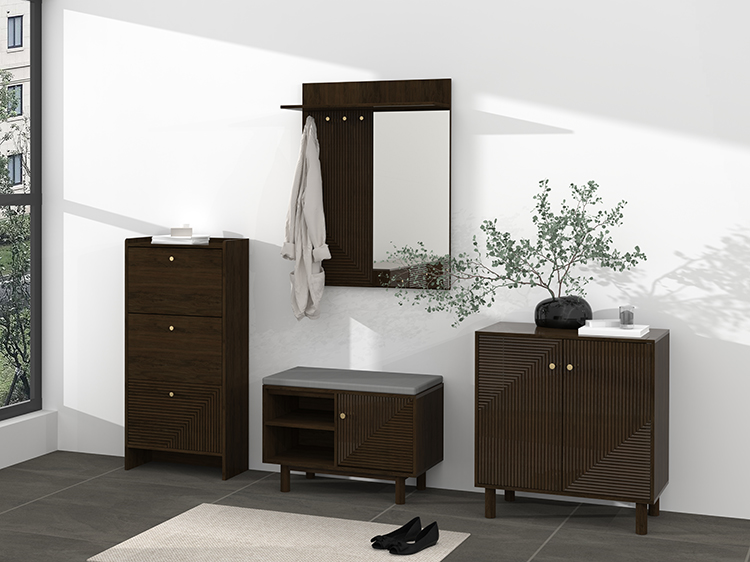
Let’s be honest. Modern manufacturing is so good right now that a premium finish over a high-density MDF core can fool almost anyone.
If you are paying top dollar to import a solid wood bedroom collection, you need to know exactly what’s inside the box before it leaves the port. As a supplier that ships thousands of engineered panel pieces and is now rolling out new solid wood designs, we see the tricks of the trade every day.
Whether you are walking a showroom or sending a third-party QC to the factory, here is how you spot the real deal.
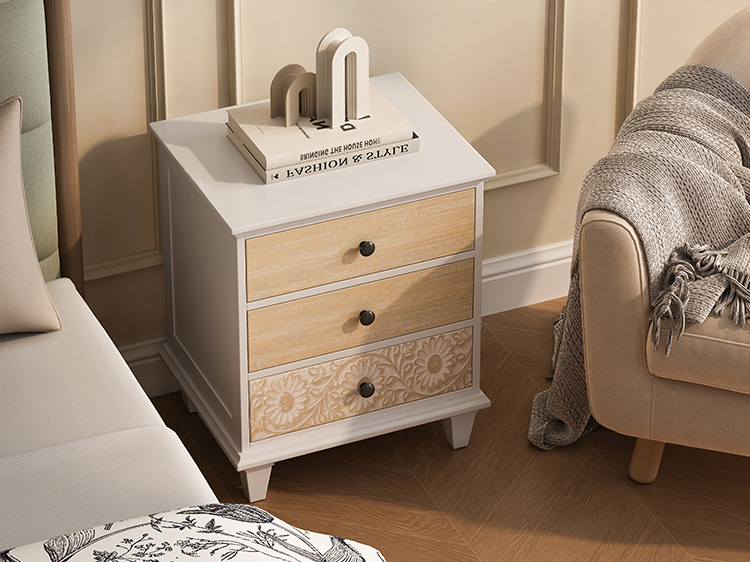
1. Look for the Edge-Banding Seam
This is the ultimate giveaway. Natural wood has a continuous grain. If you look at the corner of a solid wood nightstand, the grain on top should flow right over the edge and down the side.
If a factory uses MDF with a wood veneer, they have to cover the raw cuts with edge-banding. Look closely at that 90-degree corner. If you see a faint line where the top meets the side, or if the wood grain suddenly stops or changes direction at the edge, you are looking at a veneered board.
2. Spot the "Clone" Grain
Real wood is unpredictable. It has knots, color variations, and random grain directions.
Factories that mass-produce veneered or paper-laminated furniture buy their surface materials in massive rolls. Walk up to a wardrobe and look at the double doors. If the grain pattern on the left door is a perfect mirror image or an exact clone of the right door, it’s a manufactured finish. Mother Nature doesnt copy and paste.
3. Check the Ugly Spots
Factories protect their margins. Nobody wastes expensive solid wood where the customer wont see it.
Pull a drawer all the way out. Flip a nightstand upside down. Look behind the headboard. If a piece is genuine solid wood, those hidden spots will still be real wood (even if its a cheaper secondary species or left unpainted). But if you look under a desk and see a flat, smooth, brown board, you just found the exposed MDF core.
4. The CNC Carving Test
A lot of trending designs right now feature fluted panels or heavy floral carvings. Here is where it gets tricky, because both materials can be carved—but they look different up close.
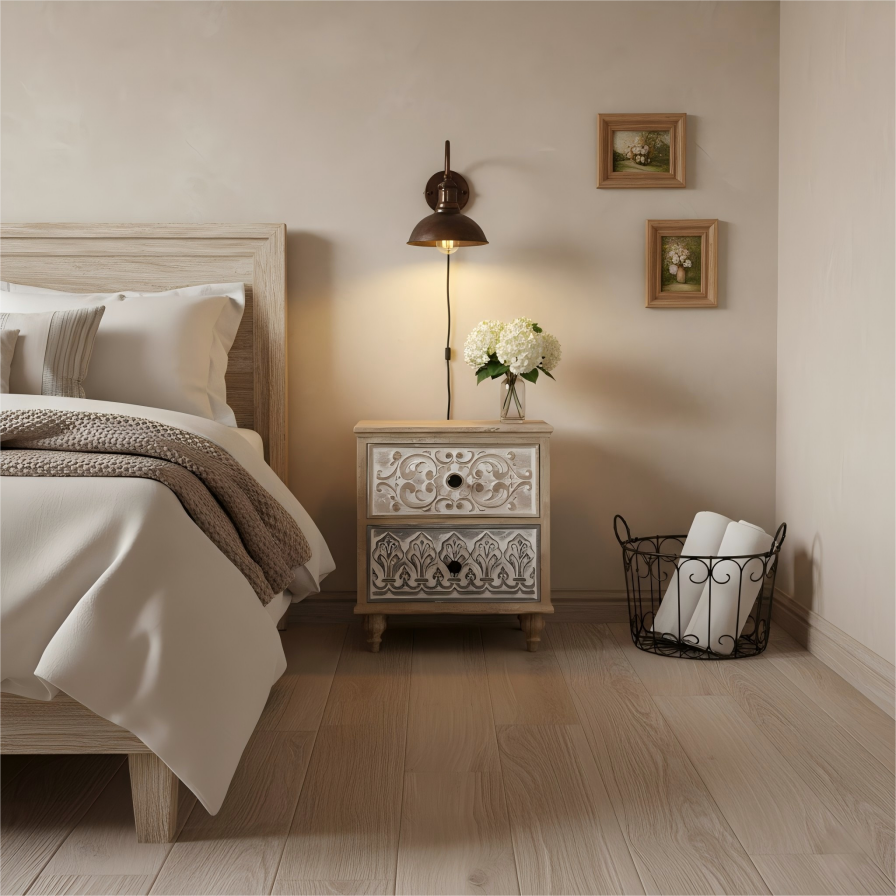
High-density MDF is actually brilliant for deep CNC routing. We use it extensively for our own Daisy carving series because the engineered core doesnt splinter like natural wood. However, once MDF is carved, the factory has to seal it using vacuum-pressed thermofoil or multi-layer lacquer.
So, how do you tell them apart? Look closely inside the carved grooves. If the natural wood grain continues down into the cut, it’s solid wood. If you see a beautiful, deep carving but the inside of the groove is perfectly smooth with absolutely no wood grain, you are looking at expertly routed MDF.
A Quick Reality Check: Is 100% Solid Wood Always Better?
Not always. Finding MDF in your order doesn’t necessarily mean a supplier is scamming you. In fact, hybrid designs are often the safest bet for wholesale buyers.
Shipping a massive slab of solid wood to the dry heat of the Middle East or the changing climates in North America is asking for cracking and warping. We frequently use solid wood for structural frames and legs, but use high-density MDF for large flat panels (like wardrobe doors). This hybrid build gives your buyers the premium aesthetic they want, without the climate risks and high shipping costs.
Sourcing FAQ: Solid Wood vs. Engineered Wood
Q: If a piece of furniture is really heavy, does that mean its solid wood?
A: No. This is a common trap. Commercial-grade, high-density MDF is incredibly heavy—sometimes even heavier than certain species of natural wood. Never rely on the "lift test" alone.
Q: What exactly is wood veneer?
A: A veneer is a paper-thin slice of real, natural wood (like oak or walnut) glued onto an engineered core (like MDF). It looks perfectly real because the surface is real wood, but it allows factories to ship flat-pack and keeps the panels from warping.
Q: How do we enforce material checks during production?
A: Instruct your QC inspector to skip the shiny showroom surfaces. Tell them to check the unpainted undersides of the furniture and run their fingernail along the corners to check for edge-banding seams. If you are buying solid wood, it should be solid all the way through.