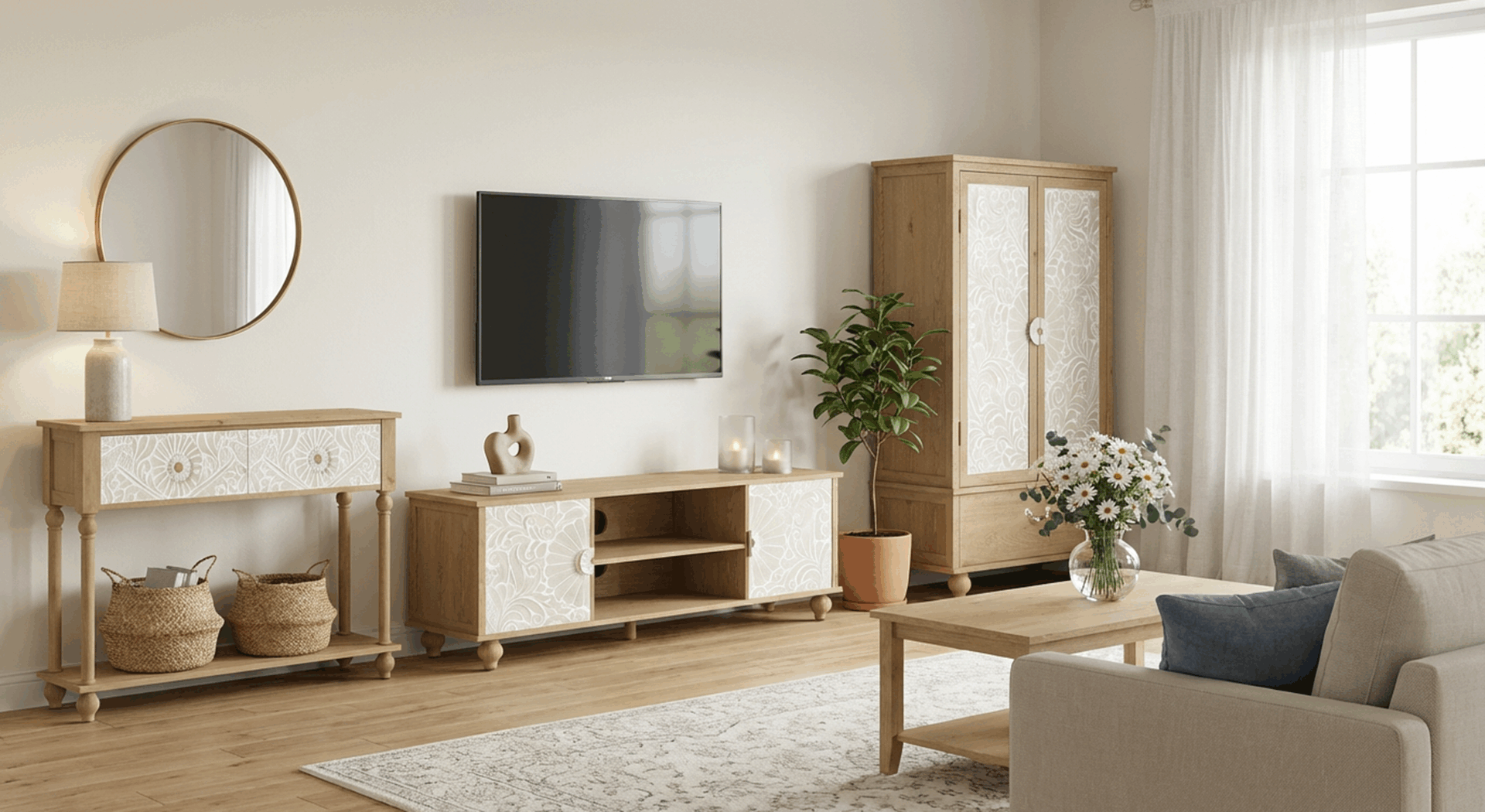
For furniture brands, kitchen studios, and property developers, a kitchen hutch odm partnership offers
a pathway to exclusive, ownable designs without in-house manufacturing. Unlike
OEM (where the factory builds to the buyer's existing drawings), ODM means the
supplier provides both design and production—allowing brands to launch
proprietary hutches faster and with lower upfront engineering costs. This guide
dissects the technical and commercial layers of a successful kitchen hutch odm project: from
initial concept sketching, material selection, structural testing, to container
loading and intellectual property protection.
1. The ODM Design Process: From Market Brief to Technical Package
A kitchen hutch odm project begins with a product requirement
document (PRD). The manufacturer's design team then develops 3D models,
renderings, and engineering drawings. Key milestones:
Concept development (weeks 1–3) – Buyer provides target
dimensions, style references (modern, farmhouse, transitional), functional
requirements (number of drawers, shelves, glass doors). Supplier creates 3–5
initial CAD concepts using SolidWorks or similar.
Material and finish proposal (week 4) – Supplier recommends
wood species (solid oak, maple, walnut), panel substrates (plywood, MDF), and
finish systems (conversion varnish, 2K poly). Includes cost impact for each
option.
Structural engineering (week 5–6) – Finite element analysis
(FEA) for shelf deflection and load paths. Joint design (dovetail, mortise &
tenon, cam lock) is optimized for durability and flat-pack shipping if
required.
Prototype sampling (week 7–9) – One fully functional sample
produced, shipped to buyer for approval. Includes hardware samples (hinges,
slides, knobs).
Essent Home assigns a
dedicated project engineer for each kitchen hutch odm client, providing weekly design reviews and
3D VR walkthroughs before cutting wood.
2. Material Selection Criteria for ODM Hutches: Balancing Cost, Durability,
and Aesthetics
Unlike OEM where materials are strictly dictated, ODM allows the manufacturer
to propose value-engineered alternatives. However, the buyer must verify
substrate specifications.
Solid wood species – For visible frames and doors. Red oak
(moderate cost, open grain), hard maple (light color, closed grain), American
walnut (premium, dark). Specify moisture content 6–8% to prevent post-production
warping. Avoid rubberwood for high-moisture environments (near sinks).
Plywood grades – For sides, shelves, and backs. Use birch
or poplar core, 7-ply minimum for 18 mm shelves. Face veneer thickness 0.6 mm,
grade A (no patches). Reject plywood with voids or core gaps.
MDF for painted finishes – Density ≥720 kg/m³ for edge
screw holding. For kitchen hutch ODM components with routed profiles
(decorative arches), specify fine-fiber MDF to prevent fuzzing.
Glass type – For display doors: 4–5 mm clear or low-iron
tempered glass (safety requirement). Frosted or seeded glass adds 20–30% to
material cost.
Request a material declaration sheet from your kitchen hutch odm supplier, including source mill and
formaldehyde test reports.
3. Joinery and Assembly Systems for ODM Production Volumes
ODM factories typically optimize joinery for repeatability and speed without
sacrificing strength. Three common systems:
Dowel and glue construction – For fully assembled hutches.
8×30 mm beech dowels, 2–3 per joint, with PVA type II glue. Clamping pressure
2–3 kg/cm² for 30 minutes. Resulting joints withstand 150 kg shear force.
Cam lock and dowel (RTA/KD) – For flat-pack kitchen hutch
ODM products. Cam lock bodies: zinc-plated steel, 15 mm diameter. Torque
retention after 10 assembly cycles: minimum 10 Nm. Dowels with spiral grooves
improve glue distribution.
Mortise and tenon for face frames – Used on higher-end ODM
hutches. Tenon length = 2× thickness, glued with polyurethane adhesive. Corner
blocks with screws add rigidity for wide hutches (>1200 mm).
Essent Home performs random
pull tests (ASTM D1037) on each production batch of kitchen hutch odm units, ensuring joint integrity exceeds
BIFMA standards.
4. Hardware Integration: Specifying for High-Cycle Reliability
Hardware failures are the number one warranty claim for kitchen hutches. ODM
buyers must approve specific brands or grades.
Hinges – For glass doors: concealed clip-on hinges with
soft-close. Minimum 100,000 cycle certification (DIN EN 15570). Acceptable
brands: Blum, Hettich, Grass. Reject generic hinges without branding.
Drawer slides – Full-extension, ball-bearing, 45 kg load
capacity. Under-mount slides (Blum TANDEM) provide cleaner look and soft-close
but cost $10–15 more per pair than side-mount.
Knobs and pulls – For kitchen hutch ODM hardware, specify solid brass or
zinc alloy with 48-hour salt spray resistance. Thread size M4 or 8-32, length 25
mm.
Glass door latches – Magnetic catches with rubber bumpers.
Opening force 8–12 N.
Request that your kitchen hutch odm supplier provides manufacturer certificates
of conformance for each hardware batch.
5. Finish Systems: Durability Testing and Application Protocols
The finish defines the product's resistance to kitchen grease, moisture, and
cleaning agents. ODM factories typically offer several systems.
Conversion varnish (acid-catalyzed) – Two-part,
post-catalyzed. Hardness 2H–3H pencil. Chemical resistance: passes 100 double
rubs with acetone (ASTM D1308). Cure time 24 hours at 21°C. Preferred for
high-use hutches.
2K polyurethane (paint) – For colored finishes (white,
gray, navy). Primer + topcoat, total dry film 80–100 µm. Cross-hatch adhesion
≥4B (ASTM D3359). Gloss levels from 10 to 90.
UV-cured clear coat – For flat components (doors, shelves).
Instant cure, zero VOCs. Hardness 3H–4H. Not suitable for assembled hutches due
to shadow areas.
Oil-based stain + lacquer – Traditional for wood grain.
Stain penetration 0.1–0.2 mm, followed by pre-cat lacquer. Less chemical
resistant than conversion varnish but easier to repair.
Essent Home operates a
climate-controlled spray booth with viscosity monitoring and records finish
thickness per kitchen hutch odm batch.
6. Quality Control and Production Tolerances for ODM Orders
ODM production runs require rigorous in-process inspection (IPI) and final
random inspection (FRI). Key checkpoints:
Dimensional check – Width ±1.5 mm, depth ±1 mm, height ±2
mm. Diagonal squareness deviation ≤3 mm per 1000 mm. Use calibrated steel tape
measure.
Surface finish – No orange peel, runs, or dust >0.5 mm.
Gloss uniformity within 5 gloss units. Adhesion tested weekly with cross-cut
tape.
Hardware installation – All screws fully seated, hinge
adjustments functional, drawer slides operate smoothly without binding.
Packaging integrity – Carton ECT ≥32, corner protectors in
place, glass doors protected with film + cardboard. Drop test (46 cm height, 1
corner, 3 edges, 6 faces) per ISTA 3A.
For kitchen hutch ODM quality assurance, require a
Certificate of Analysis (COA) for each container, including photos of random
samples.
7. Intellectual Property Protection in ODM Agreements
When a kitchen hutch odm supplier creates a design exclusively for
your brand, ownership must be contractually defined. Critical clauses:
Design ownership – All CAD files, drawings, and tooling
paid by buyer remain buyer's property. Supplier cannot sell the same design to
other clients.
Non-disclosure agreement (NDA) – Covers product
specifications, pricing, and target markets.
Exclusivity period – Typically 2–3 years during which
supplier cannot produce similar hutches for competitors in the same region.
Mold and tooling amortization – For custom extrusions or
injection-molded parts, specify cost amortization schedule (e.g., over 5,000
units).
Essent Home provides
standard ODM agreements with full IP protection and has never been involved in
design disputes.
Frequently Asked Questions (FAQ)
Q1: What is the typical minimum order quantity (MOQ) for a custom
kitchen hutch ODM project?
A1: For a fully
exclusive design (new tooling, unique dimensions, proprietary finishes), MOQ
usually ranges 100–200 units. For a semi-custom ODM (existing supplier design
with minor modifications like color or hardware), MOQ can be 30–50 units.
Essent Home accepts sample
orders of 1–5 units for design validation before committing to mass production
of your kitchen hutch odm.
Q2: How long does the ODM development phase take from concept to
first production run?
A2: On average, 12–16 weeks:
design (3–4 weeks), material selection (1 week), prototyping and revisions (4–5
weeks), tooling (2 weeks), pilot run (1 week), and final approval (1 week).
After sample approval, bulk production lead time is 30–45 days for 200–500
units. Rush ODM projects (with existing design library) can be as fast as 8
weeks total.
Q3: Can I request a specific finish color not in the supplier's
standard palette?
A3: Yes. Professional kitchen hutch odm manufacturers
offer custom color matching using spectrophotometer (ΔE <1.0). Provide a RAL,
Pantone, or physical sample. Custom stain matching for wood requires a 100×100
mm wood sample. A color match fee of $200–400 applies, waived for orders above
300 units.
Q4: What certifications should an ODM supplier hold for kitchen
hutches?
A4: Minimum: ISO 9001:2015 (quality
management), FSC chain-of-custody, CARB Phase 2 or EPA TSCA Title VI
(formaldehyde). For export to EU: CE marking, REACH compliance. For
contract-grade projects: BIFMA X5.9 certification. Essent Home holds all above
certifications and provides batch-specific test reports for every kitchen hutch odm shipment.
Q5: How are warranty claims handled in an ODM
arrangement?
A5: Standard ODM agreements include:
(a) Defect classification – critical (structural, safety) vs. minor (cosmetic).
(b) Claim window – 30 days from delivery for visible defects, 12 months for
hidden defects. (c) Remedy – supplier provides replacement parts or credit for
defective units, typically 3–5% of order value as standard allowance. Request a
sample warranty clause from your kitchen hutch odm partner before signing.
Q6: What is the cost difference between OEM and ODM for kitchen
hutches?
A6: For a comparable design and quality
level, ODM unit cost is typically 10–20% lower than OEM because the supplier
spreads design and engineering costs across multiple clients (non-exclusive
designs). For fully exclusive ODM (unique design owned by buyer), unit cost may
be 5–10% higher than OEM due to dedicated tooling and lower volume amortization.
Always request a kitchen hutch ODM cost breakdown before comparing
quotes.
Request a Custom Kitchen Hutch ODM Quotation for Your Brand
Launching an exclusive kitchen hutch odm line allows you to differentiate from
mass-market competitors without in-house manufacturing overhead. Essent Home offers
end-to-end ODM services: market research, industrial design, 3D rendering,
structural engineering, prototype sampling, mass production with ISO 9001
controls, and global logistics. Submit your initial brief (target dimensions,
style references, estimated annual volume, target FOB price range) for a
non-disclosure agreement and a free design feasibility study.
Send your inquiry to Essent Home ODM team → https://essentfurniture.com/contact.html (or use the online
form). Attach reference images or sketches for a preliminary quote within 5
business days.